
10 Best European City Breaks for UK Travellers
10 Best European City Breaks for UK Travellers
European city breaks represent one of the most efficient uses of limited annual leave a traveller can make. Europe contains hundreds of cities that could genuinely change your perspective on travel, yet most UK travellers end up cycling through the same four or five, not because those are the only worthy options, but because nobody has handed them a sensible framework for choosing. A well-planned city break is accessible, affordable and genuinely restorative in a way that a fortnight of inertia rarely is. The question isn't whether to go. It's which city, for how long, at what cost, and whether you're brave enough to combine two in one trip. This guide answers all of those questions.
At Skylord Cruise and Holidays, we've been building European itineraries for UK travellers for years, and the same three questions surface in every conversation: which cities are actually worth it, how long do you need, and how much should you budget? What follows is our honest, experience-backed answer.
10 Best European City Breaks that Consistently Deliver
The most useful way to choose a destination for a European weekend getaway is not by ranking cities against each other, but by matching them to what you want the trip to feel like. Some cities reward speed and energy; others reward slowness. Some will stretch your pound surprisingly far; others demand a larger budget but justify every penny. Here are ten that consistently deliver across different travel personalities and budgets, from iconic capitals to quieter cities with serious character.
The icons that still earn their reputation
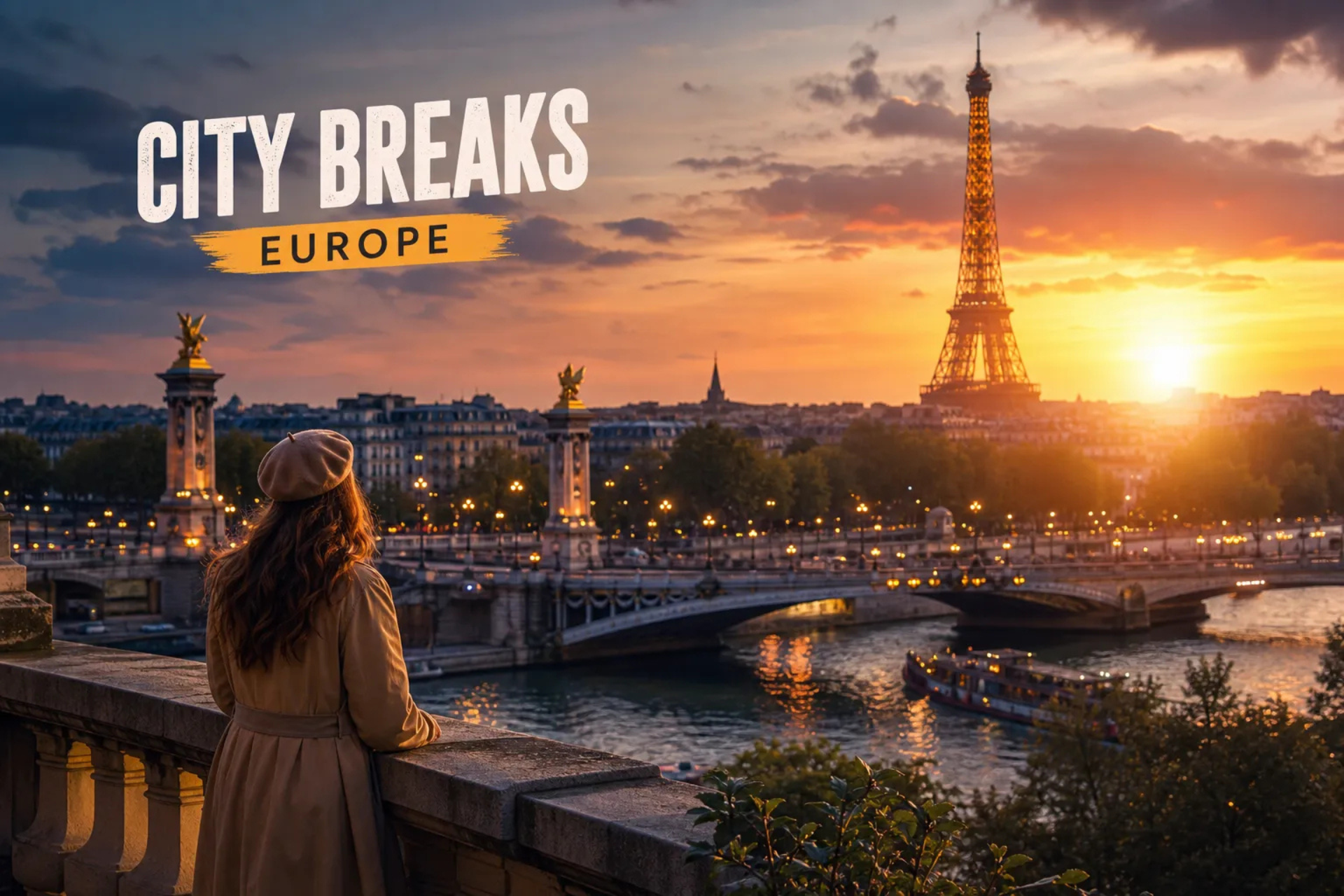
Paris, Rome and Barcelona top virtually every list of popular short breaks in Europe, and they do so for good reason. Paris offers a particular kind of elegance that no other city quite replicates: the café culture, the art, the architecture, the unhurried sense that beauty is simply the baseline. Rome layers ancient history onto genuinely lived-in street life in a way that rewards wandering far more than rigid sightseeing schedules. Barcelona brings beaches, Gaudí's inventive architecture, and a pace that accommodates families, couples and solo travellers with equal generosity.
Paris is accessible via Eurostar in two hours and sixteen minutes from St Pancras, which remains a compelling option for London-based travellers who prefer to avoid the airport altogether. All three cities are reachable from London by flight in well under three hours. These are cities that are popular precisely because they deliver. The crowds are real, but so is the reward.
Europe's best-value city breaks
Prague, Budapest and Kraków represent some of the strongest value available anywhere in Europe for UK travellers. Based on 2026 daily-cost estimates, a budget traveller in Budapest can manage comfortably on around £45 to £55 per day, covering accommodation, food and activities. Prague and Kraków sit in a similar range. These aren't compromise destinations; they're places where your pound genuinely stretches into something that feels indulgent. For further reading on recognised budget cities in Europe, there are several useful round-ups that confirm these choices.
Prague's imperial architecture rivals Vienna's at a fraction of the cost, typical mid-range hotel rates in Prague run at roughly half those in Vienna, and its compact old town is one of the most walkable in Europe. Budapest's thermal baths and celebrated ruin bars offer an experience with no real equivalent elsewhere on the continent. Kraków's medieval old town is among the best-preserved in Central Europe, with a cultural depth that surprises even experienced travellers. For travellers seeking maximum experience at minimum spend, these three cities are the clear answer.
Smaller cities with outsized character
Lisbon, Vienna, Porto and Copenhagen each reward travellers who want to step slightly off the most well-worn path without sacrificing comfort or quality. Lisbon earns its reputation through a particular atmospheric quality, faded azulejo tiles, the mournful pull of fado drifting from a doorway, hills that open suddenly onto wide estuary views, and its food scene is among the most exciting in western Europe. Vienna offers world-class museums, imperial architecture and an unhurried elegance that suits a certain kind of traveller perfectly. Porto delivers a 48-hour escape that punches well above its modest size, particularly for those drawn to wine, dramatic riverscapes and characterful neighbourhoods. Copenhagen brings clean Scandinavian design, some of Europe's most celebrated dining, and a city centre compact enough to explore entirely on foot.
How Long You Actually Need: European City Break Durations
In our experience, 48 to 72 hours is the sweet spot for compact cities, while larger capitals reward three to four nights. Knowing which category your chosen city falls into makes a significant difference to how you plan and budget, and whether a long weekend is genuinely enough or simply a taster.
The 48-hour sweet spot
Porto, Prague, Budapest and Copenhagen can all be explored meaningfully in two full days. These cities are geographically compact, their main sights cluster within walking distance of each other, and their essential character emerges quickly. A 48-hour trip from the UK is entirely practical: fly out Friday morning, return Sunday evening, and you've had a genuine break without burning through annual leave. Short-haul city breaks structured around a weekend work particularly well when you choose a city that rewards walking over scheduling.
When 3, 4 nights earns its place
Paris, Rome and Barcelona each have enough depth to justify an extra night or two. Barcelona's distinct neighbourhoods alone reward slow exploration: the Gothic Quarter, El Born, Gràcia and Barceloneta each have their own character and could fill a day each. Rome's layers of history make rushing feel like a genuine waste. For these cities, three nights is the minimum that lets you move at a human pace. Four nights edges toward a proper short holiday rather than a city break, which opens a different set of possibilities, including the option of combining two destinations in a single trip.
What a European City Break Actually Costs in 2026
The honest answer is that costs vary more by travel style than by destination, but destination still matters considerably. Using Paris as a benchmark, a three-night trip with return flights from the UK and central accommodation typically runs around £300 to £450 for budget-conscious travellers and £650 to £900 at mid-range. If you're trying to understand whether Paris is expensive, there are practical breakdowns that help explain where the money goes. These figures are illustrative estimates that factor in both flights and accommodation; exact costs will vary by departure airport, season and booking timing. Prague and Budapest generally sit at the lower end of those ranges and sometimes below them. Rome and Barcelona are closer to the Paris level for accommodation, though food and activities remain slightly cheaper in Rome.
Luxury travel to any of these cities rises steeply. A Paris five-star weekend can clear £1,500 per person before extras without difficulty. The more interesting observation is that mid-range travel to Budapest or Prague delivers an experience that feels genuinely luxurious: excellent restaurants, handsome hotels and a sense that you're not competing with everyone else for a table or a taxi. The value cities offer something the iconic capitals can't: the feeling of abundance without the premium price tag. For a practical budgeting example focused specifically on a Paris week, see this Paris week budget guide that maps typical expenditures.
Getting there from the UK
Flight times from London vary considerably by destination. Paris and Amsterdam are around one hour to one hour and fifteen minutes; Barcelona is closer to one hour fifty to two hours. Prague and Budapest are under two and a half hours. From Manchester and Edinburgh, journey times to most European destinations are broadly comparable to London, though individual routes vary, check specific flight times when booking rather than applying a blanket rule. Eurostar from St Pancras to Paris runs in two hours and sixteen minutes and is a genuinely practical alternative for London-based travellers who prefer to avoid airports entirely. For cities beyond Paris and Amsterdam, flying is the only practical option on a short break. If you want to quickly check which destinations have the short flight times from the UK, there are concise lists that help plan efficient itineraries.
On fare timing, booking one to three months ahead typically secures competitive prices for most European routes, though popular summer departures can reward earlier planning. Prices fluctuate considerably, so the best approach is to set a fare alert and book when you see a price you're comfortable with.
Timing Your Visit and Booking it Smartly
Spring (April to May) and early autumn (September to October) are the optimal windows for most of these cities. You get pleasant temperatures, manageable crowds and lower accommodation prices than peak summer. July and August bring the largest crowds to Barcelona and Rome; Prague and Budapest are more manageable but still busy during peak summer months. Copenhagen and Vienna are genuinely good year-round, with winter offering a particularly atmospheric and quieter experience for those who don't mind shorter days.
The practical filter here is simple: match your city choice to the time of year you're travelling, rather than booking a city and then wondering when to go. If you're travelling in July, Budapest will serve you considerably better than Rome. If you have flexibility around shoulder season, Paris in May is a different and superior city to Paris in August.
A few booking habits consistently make a difference. Arranging accommodation and flights together, or through a single operator, reduces coordination headaches. For Paris and Amsterdam specifically, it's worth booking airport transfers or city-centre train tickets in advance, transfer costs at both destinations can catch travellers off guard if left to the last minute. Setting a daily budget before you depart also helps; travellers who plan their daily spend in advance tend to enjoy their trips more and overspend less. Museum passes and city cards offer genuine value in Vienna, Paris and Barcelona. In smaller cities like Porto or Kraków, they're rarely worth the investment.
Why the Smartest Travellers Are Combining Two European City Breaks in One Trip
A single well-chosen city break is satisfying. Two cities in one trip creates something richer: a more textured experience, a clearer sense of contrast and character, and the kind of trip that stays with you considerably longer. The traveller who spends three nights in Prague and two nights in Vienna returns home with a story. The traveller who spends five nights in Prague returns home with a very thorough knowledge of one city. Both are valid choices, but the two-city version tends to be the one people talk about for years afterwards.
City pairings that work beautifully together
Certain cities are natural companions because of their proximity and contrasting character. Prague and Vienna sit roughly four hours apart by direct train and make for a satisfying pairing: Baroque grandeur alongside Bohemian edge, imperial elegance alongside genuine eccentricity. For travellers who like a ready-made itinerary, our Skylord Cruise and Holidays, Prague, Vienna & Budapest, Timeless Charm City Holiday demonstrates this interplay in a packaged format. Barcelona and Lisbon connect easily by short flight and give you two distinct takes on southern European coastal life. Paris and Amsterdam are both accessible from London via Eurostar, making a two-city loop genuinely straightforward for London-based travellers. Budapest and Kraków reward those who want maximum cultural depth at minimum cost. These pairings work as frameworks to adapt rather than fixed itineraries to follow.
Taking the planning stress out of a multi-city trip
Combining two or three cities in one trip means coordinating flights or trains, timing check-ins and check-outs, and sequencing your itinerary so you're not spending half your break in transit. When it comes together, it is one of the most rewarding ways to travel in Europe. When it doesn't, it becomes a logistics operation that leaves you more exhausted than when you left. This is precisely the kind of problem that Skylord Cruise and Holidays sorts with its extensive offers of city breaks including multi-centre European holiday packages.
Rather than piecing together separate bookings across multiple platforms, a single multi-centre package handles the movement between cities, the accommodation at each stop, and the sequencing of your itinerary. The only decision you need to make is which cities excite you most. For travellers who want the richness of two or three European destinations without the administrative burden, it's the most straightforward way to travel.
The Right Framework Changes Everything
The best European city breaks share one thing: they were chosen deliberately rather than by default. The ten cities in this guide each offer something specific and distinct; the key is matching them to what you actually want from a short break rather than defaulting to whichever name you've vaguely heard of. Whether you choose Prague for its remarkable value, Barcelona for its energy, or Lisbon for its quiet and particular beauty, a well-chosen European city break can feel like a genuine reset rather than just a tick on a travel list.
If two cities are calling you at once, that's not a problem to be managed, it's a trip worth planning properly. The only question is how you want to organise it. If the answer is "as smoothly as possible, with someone else handling the logistics," speak to the team at Skylord Cruise and Holidays. We've been putting these itineraries together for years, and we know exactly which pairings sing. See an example of our multi-centre offering with the Skylord Cruise and Holidays, top package, Lisbon & Porto 6 Night Twin Centre City Break Package.