10 Reasons to Choose Morocco & North Africa for Your Next Holiday
10 Reasons to Choose Morocco & North Africa for Your Next Holiday

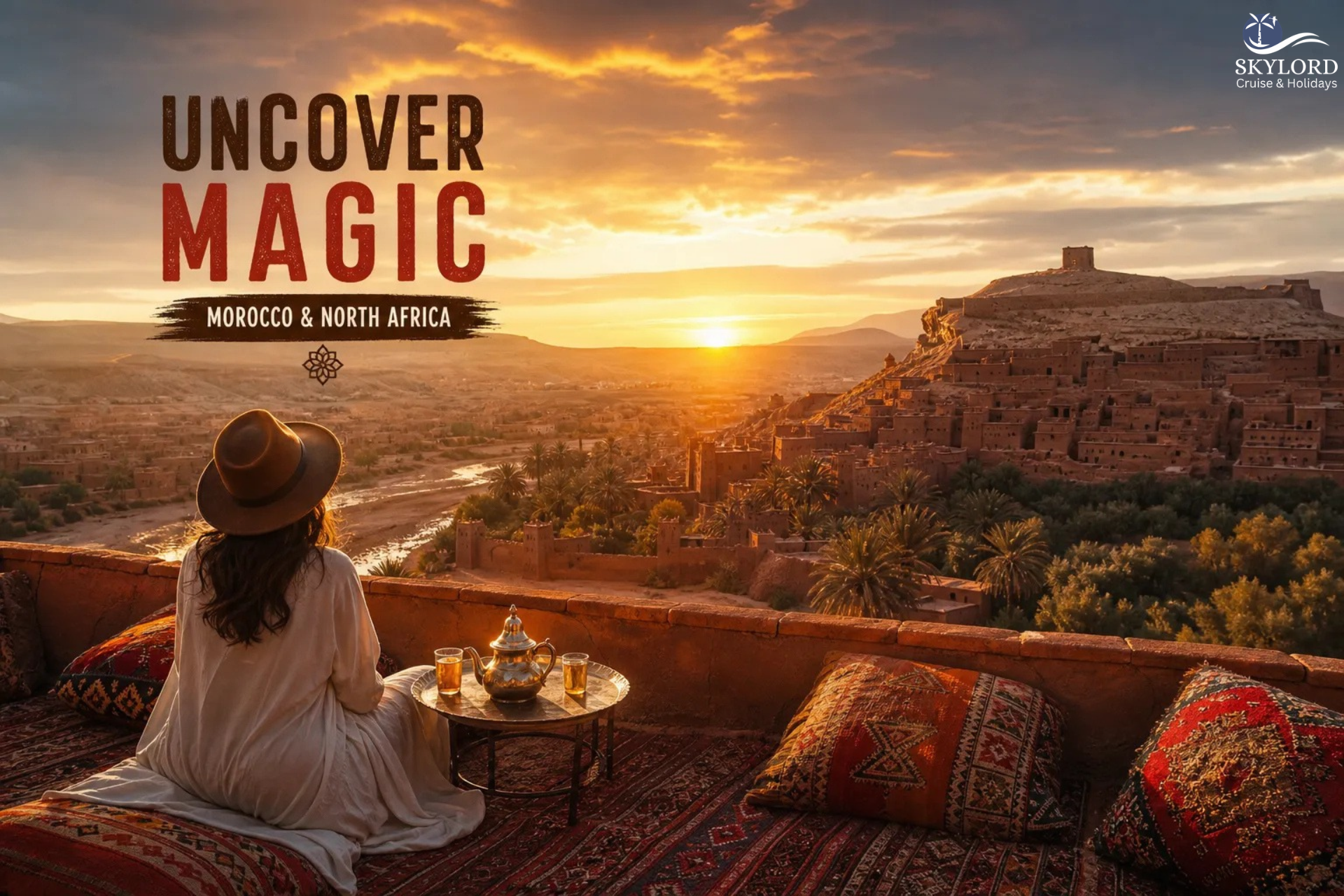
There is a particular kind of holiday that doesn't just take you somewhere new. It takes you somewhere that makes you question how you ever settled for less. Morocco, in North Africa, is that kind of place. Sitting at the exact point where Africa, Europe, and the Arab world collide, it is not so much a single destination as a collection of worlds stacked against each other: mountains against desert, ancient medinas against Atlantic breeze, a call to prayer echoing over a square where the same fire-eaters and storytellers have performed for centuries.
The Kingdom of Morocco occupies the northwest corner of Africa, separated from southern Spain by just 14 kilometres of water at the Strait of Gibraltar. Flights from the UK typically take around three to four hours depending on your departure city, yet the cultural distance from London to Marrakech is something closer to centuries. That contrast is precisely what makes Morocco North Africa so compelling, and why a well-planned trip here rewards the traveller who goes deeper and stays longer. At Skylord Cruise and Holidays, we have been sending clients to Morocco for years, and the feedback we receive, time and again, is that it exceeds expectations.
What follows are ten reasons, grouped into the themes that matter most, for choosing Morocco as your next multi-centre holiday. These are not abstract talking points. They are the specific qualities that make this corner of Morocco North Africa unlike anywhere else within reach of a British passport.
1. A kingdom of contrasts: Morocco North Africa's geography and landscape
Morocco spans four broad geographic regions, the Rif Mountains, the Atlas ranges, the Atlantic coastal plain, and the Saharan south, and each one feels like a different country. Most travellers arrive expecting sand. What they encounter instead is a country of genuine geographic complexity, and one that rewards the curious traveller at every turn.
Reason 1: Morocco's position at the crossroads of continents
The Strait of Gibraltar is just 14 kilometres wide at its narrowest point, and Morocco sits on the far side of it, bordered by the Atlantic Ocean to the west and the Mediterranean Sea to the north. To the east lies Algeria; to the south, the disputed territory of Western Sahara, where Morocco administers roughly 85% of the land behind a contested frontier. This crossroads positioning puts Morocco within easy reach of British travellers, yet the moment you land, the world feels fundamentally different. Morocco is undeniably African, unmistakably Arab, and quietly shaped by centuries of European contact, all at once.
Reason 2: Four landscapes in one country
Think of Morocco as terrain that actively shapes how you travel through it. The Rif Mountains in the north receive more rainfall than most of the country, creating a lush, Mediterranean green that surprises travellers who expect only dust. The High Atlas range runs through the interior, holding snow well into spring, with peaks exceeding 4,000 metres. The Atlantic coastal plain is mild and breezy year-round, moderated by the ocean. Then the landscape dissolves, through the dramatic Draa Valley, into the Saharan south: arid, vast, and extraordinary. Very few destinations this accessible from Britain pack this much geographic variety into a single itinerary.
Reason 3: A climate that works for almost every kind of traveller
Spring and autumn are the golden seasons for inland cities and mountain trekking, with April and October consistently recommended as the strongest individual months. Summer draws beach lovers to the Atlantic coast, where ocean breezes keep temperatures manageable in towns like Essaouira and Agadir. The Sahara comes alive in the cooler months between October and April, when camel treks and overnight desert camps are a genuine pleasure rather than an endurance test. Whatever week a British traveller can get away, there is a corner of Morocco in season.
2. The cities that define Morocco's soul
Great travel writing does not describe cities as lists of attractions. It describes them as states of mind. Morocco's imperial cities each offer a different lens through which the kingdom reveals itself, and no multi-centre trip is complete without at least two of them.
Reason 4: Marrakech, where every sense is overwhelmed at once
Marrakech is Morocco's most visited city, and the reason is straightforward: there is nowhere else quite like it. Jemaa el-Fna square transforms from a busy market into a full carnival as the sun drops, with food stalls, musicians, and storytellers filling the space late into the evening. The medina is a maze that actively rewards the traveller who gets deliberately lost in it. Beyond the spectacle, Marrakech has evolved into a genuinely sophisticated destination: rooftop riads with plunge pools, restaurants earning international recognition, and day-trip routes into the Atlas foothills, the Ourika Valley, for instance, sits around 30 to 90 minutes from the city centre depending on your destination.
Reason 5: Fes, one of the world's oldest living medieval cities
If Marrakech is Morocco's showpiece, Fes is its conscience. The Medina of Fes is a UNESCO World Heritage Site and home to the University of al-Qarawiyyin, widely regarded as one of the oldest continuously operating universities on earth. Its tanneries, souks, and madrasas have changed little in centuries; leather is still dyed in stone vats using methods that predate the printing press. Fes is the ideal destination for travellers who want to understand Morocco rather than simply photograph it. Many visitors find that even two full days leave much of the medina unexplored, the neighbourhood of Andalusian Fes alone merits a half-day on its own.
Reason 6: Essaouira, the Atlantic escape that slows everything down
Essaouira offers something the imperial cities cannot: quiet. Its whitewashed ramparts overlook a restless Atlantic, its streets are cooled by ocean wind year-round, and its arts scene has attracted musicians, painters, and writers for decades. The pace here is entirely different from Marrakech, which is exactly the point. Inserted into a multi-centre itinerary after the intensity of the medinas, Essaouira is the place where the trip breathes.
3. Wild adventures worth planning a trip around
Certain travel experiences are pleasant additions to a holiday. Others are the kind that stay with you for decades, the moments you describe to people who weren't there and find yourself unable to do justice to. The Sahara and the Atlas Mountains tend to fall into the second category.
Reason 7: A night in the Sahara Desert
The Saharan dunes of Merzouga are best visited between October and April, when temperatures allow for camel treks at dusk, overnight camps under an unobstructed sky, and a pre-dawn silence that no city in the world can replicate. From Marrakech, the route crosses the Atlas before dropping through the Draa Valley towards the Saharan south, and the sense of travelling into something genuinely remote builds with every kilometre. For most travellers who do it, a night in a desert camp at Erg Chebbi is the moment the trip shifts into something they hadn't quite anticipated.
Reason 8: Trekking the Atlas Mountains through Berber villages
The High Atlas offers some of the most rewarding trekking in North Africa, with Amazigh (Berber) communities living along routes that have been walked for centuries. Spring is the strongest season for mountain walking: snow-melt streams, wildflowers alongside the trails, and temperatures that make even a full day's hiking a pleasure. This is the reason Morocco appeals well beyond the city-break crowd. It is a genuine adventure destination, and the villages along the Atlas routes have a reputation for hospitality that walkers consistently remark upon.
4. Culture, history, and food that stay with you long after you return
Morocco's culture gets under your skin in ways you don't fully register until you're home and reaching for a tagine recipe at nine on a Tuesday evening. Its history is layered and complex; its food is one of the finest culinary traditions anywhere in the world. These are the reasons travellers return.
Reason 9: Three cultures, one kingdom, the heritage that shapes Morocco
Morocco's cultural identity is genuinely plural. Arabic and Tamazight (Berber) are both official languages, and the Amazigh heritage runs deep across the Atlas communities, the coastal towns, and the Saharan south. Islam shapes the rhythm of daily life through the call to prayer, the architecture of every medina, and the particular generosity of Ramadan hospitality, a warmth that visitors across all faiths consistently remark upon.
The country's historical layers add further depth. The legacy of Andalusian influence, carried here by Moorish communities expelled from Spain centuries ago, runs through the decorative tiles of Fes and the street layouts of Tetouan, a city whose UNESCO-listed medina is sometimes called the most Spanish city in Africa. Morocco is a constitutional monarchy divided into 12 administrative regions: a stable and proud nation at the heart of the Maghreb, with a documented history of trade and exchange with the wider world stretching back well before the age of modern tourism.
Reason 10: Moroccan cuisine, a destination in itself
Tagines slow-cooked with preserved lemon and olives. Bastilla filled with pigeon and almonds and dusted with icing sugar. Harira soup served in a clay bowl beside a souk at the end of a long day, a bowl that somehow tastes better than anything you can explain afterwards. Moroccan food is not a backdrop to the holiday; it is a central part of the story. The culinary tradition here draws on Amazigh, Arab, Andalusian, and sub-Saharan African influences in a way that produces something entirely distinctive. For many travellers, the food alone justifies the flight.
5. How to combine the best of Morocco into one unforgettable trip
Most travellers see one city and call it Morocco. The traveller who plans well sees how the whole kingdom connects, and that version of the trip is entirely different in scale, depth, and memory.
Crafting a multi-centre Morocco North Africa itinerary
A well-structured 10-day Morocco itinerary typically flows like this: arrive in Marrakech and spend two days in the medina, then head west to Essaouira for a night on the Atlantic coast. Return inland, cross the Atlas, and continue down through the Draa Valley to the Saharan dunes at Merzouga for an overnight camp. From Merzouga, the route loops north to Fes for two full days, before transferring back to Marrakech for departure. This sequence connects the country's major highlights without excessive backtracking, and it works precisely because Morocco's geography is logical once you see it on a map. Timing matters: arriving in Merzouga in peak summer heat turns a magical experience into an uncomfortable one.
Why a specialist transforms the experience
A multi-centre Morocco itinerary involves coordinating regional climate windows, internal transfers between cities that vary enormously in transport quality, accommodation that ranges from riads to desert camps, and the kind of sequencing that determines whether the trip flows or fragments. This is where working with a specialist makes a genuine difference.
At Skylord Cruise and Holidays, we build bespoke multi-centre itineraries for Morocco and North Africa that take care of every one of those logistics before you arrive: the right riads in the right locations, private transfers where trains don't reach, and the balance between guided experience and free time that suits you. A well-planned bespoke trip is not a luxury; it is the difference between a complicated holiday and a genuinely great one.
When to go and how to plan ahead
Spring, from March to May, and autumn, from September to October, are the sweet spots for most multi-centre Morocco itineraries. These windows offer manageable temperatures across the cities, comfortable conditions for Atlas trekking, and a Sahara that is spectacular rather than scorching. UK school holiday travellers should note that late October half-term often coincides with ideal weather conditions across most of the country. Booking through a specialist means the regional timing is built into the plan from the start, not something you have to research yourself.
Morocco North Africa is waiting: what comes next?
Ancient medinas with histories stretching back over a thousand years. A Saharan landscape that makes silence feel like something tangible. Mountain ranges that hold snow into April. A coastline cooled by the Atlantic. A food culture that rewards the curious eater at every meal. These are not selling points assembled by a marketing team, they are ten specific, concrete reasons why Morocco consistently surprises, moves, and stays with the travellers who choose it.
The kingdom sits at a crossroads that shaped human history: Africa and Europe almost touching, Arab and Amazigh cultures built up over centuries into something distinct and layered, a constitutional monarchy with 12 regions that each feel like a destination in their own right. No single week of travel does full justice to what Morocco offers, which is why the multi-centre approach, done well, produces the most rewarding version of the trip.
Morocco's case hardly needs restating at this point, the only question is when to go, and who to trust with the planning. Start planning your Morocco North Africa multi-centre trip with Skylord Cruise and Holidays today. Get in touch with our team to build an itinerary that gives you the full picture, not just one corner of it.