
Cruise packing tips: your complete checklist for any voyage
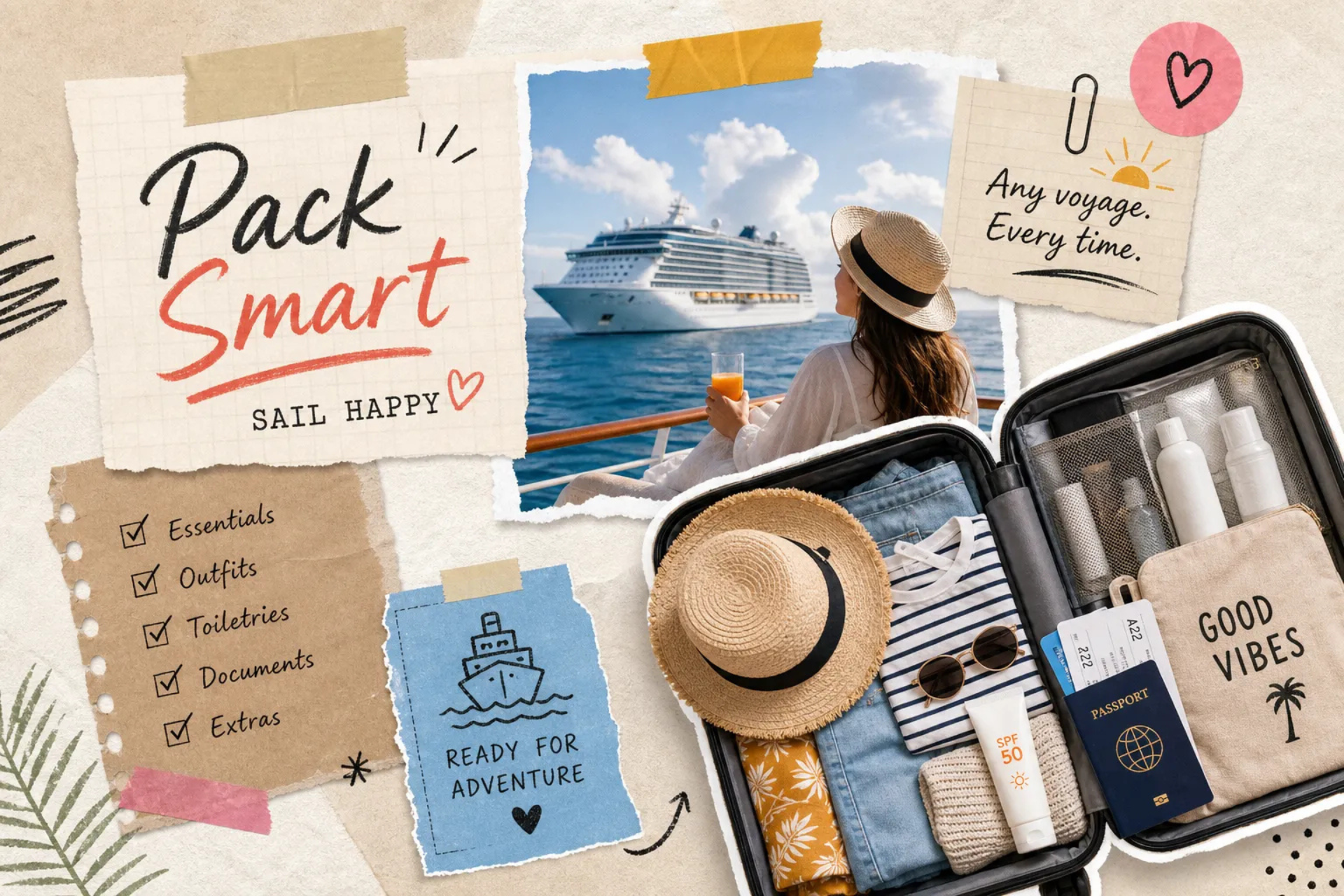
Cruise packing tips: your complete checklist for any voyage
Cruise packing tips begin with a strange paradox at the heart of every cruise holiday. The ocean stretches endlessly in every direction, offering a kind of freedom that is genuinely difficult to find on land. Yet the cabin you'll call home for the next seven nights is, in all likelihood, smaller than the average hotel room. Most people pack for the romance of that first image and completely forget to pack for the reality of the second. The result is a boarding day spent hunting for a toothbrush in the ship's shop, where onboard prices are often considerably higher than what you'd pay at home.
Getting your cruise packing right is, without exaggeration, the single decision that separates the travellers who are in the pool by noon on embarkation day from those still unpacking at dinner. This guide covers everything: what belongs in your carry-on, how to build a wardrobe around formal nights and shore excursions, which toiletries ships don't actually provide, and how to adjust your entire kit for three genuinely different cruise climates.
Cruise packing tips: your carry-on is the most important bag you'll pack
Here's something most first-time cruisers discover the hard way. Checked luggage on a cruise ship often doesn't arrive in your stateroom until early evening, the exact timing varies by ship and embarkation schedule, but if you board at noon, you may have several hours with only what's in your hands. That changes how you should think about your carry-on entirely: it isn't a backup bag; it's your primary survival kit for boarding day.
Documents and valuables that must never go in the hold
Your passport, cruise boarding documents, printed luggage tags, travel insurance details, and emergency contact cards must travel on your person. For closed-loop sailings, typically US domestic itineraries, some lines may accept a government-issued ID alongside a birth certificate, but requirements are jurisdiction-specific and vary by cruise line. For most international sailings, a valid passport is required and always the safer choice regardless. Keep credit cards and cash in your bag or jacket pocket, not in a checked suitcase. Always check your specific itinerary and port requirements before you travel.
Medications and prescriptions: pack them last, keep them closest
Prescription medications must travel in their original, labelled containers, accompanied by a doctor's note and a written copy of your prescription. Bring at least seven extra days of any maintenance medication: blood pressure tablets, thyroid medication, insulin. For over-the-counter essentials on day one, pack motion sickness remedy (Bonine or Sea-Bands both work well), pain relief, and antacids. Motion sickness medication is most effective when taken before you feel symptoms, so take it before you board rather than waiting until the ship leaves port.
The six-hour kit: what you need before your cabin is ready
One change of clothes including swimwear, sunscreen, sunglasses, a phone charger, essential medications, a basic toiletry item or two, and a small snack. That's close to the entire list, adapt it to your personal needs, but keep it minimal. This isn't emergency planning; it's smart boarding-day thinking that lets you enjoy the ship from the moment you walk on, rather than waiting around for your suitcase to materialise.
How to build a cruise wardrobe that actually works
The most common packing mistake isn't bringing too much. It's bringing the wrong things in abundance. A seven-night cruise does not require seven full outfit changes per day. It requires a considered selection of versatile pieces chosen around your destination's climate and your ship's dress expectations.
The mix-and-match formula for a 7-night cruise
The working formula is straightforward: four to five daytime outfits, three to four smart-casual dinner outfits, and one formal option. Pack a minimum of two swimsuits so one can dry while you wear the other. Choose tops that pair with multiple bottoms, and bring one blazer or wrap that transitions cleanly from a deck lunch to an evening dining room. Rewearing is not a compromise; it is the strategy. The travellers who always look put-together on ships are the ones who packed less and thought more.
Decoding cruise dress codes: from casual buffets to formal nights
Three tiers cover the vast majority of cruise evenings. Casual applies to daytime activities and the lido deck. Smart casual is the standard for most main dining room evenings, meaning collared shirts and trousers for men, and dresses or smart separates for women. Formal or gala nights, typically one to two per seven-night sailing, require a suit or sport coat for men and a cocktail dress or elegant separates for women. P&O Cruises calls these "Celebration Nights" and enforces a no-denim rule in dining venues; Cunard's "Gala Evenings" carry a similar expectation. Norwegian runs a largely freestyle policy. Always check your specific cruise line's dress policy before finalising your wardrobe, as enforcement varies considerably and being turned away from the main dining room on a formal night is a frustrating experience that is entirely preventable.
Shoes: the most underestimated item on your cruise packing list
Three pairs cover almost every situation a cruise itinerary will present: comfortable walking shoes for shore excursions, sandals for the deck and casual days, and dress shoes for evenings. Add water shoes if your itinerary includes snorkelling or rocky beach landings. Shoes eat luggage space disproportionately, so choosing dual-purpose options is worth the deliberate thought before you pack, for example, a walking shoe that doubles as a casual evening option does two jobs for the price of one.
Toiletries, health essentials, and what ships don't provide
Cruise ships provide some bathroom basics, but specific products, particularly good conditioner and specialist skincare, are rarely stocked in standard staterooms. Most cabins supply basic soap, shampoo, body wash, and body lotion. What they don't reliably stock: dry shampoo, high-SPF sunscreen, insect repellent, specialist hair products, or feminine hygiene items, which may not always be available onboard. Bring what you know you need. Knowing this before you travel is the difference between packing light and packing smart.
Sunscreen, bug spray, and port-specific protection
High-SPF sunscreen is expensive onboard and sometimes unavailable in the specific factor you need. Reef-safe sunscreen is both a responsible choice and an increasingly required one at Caribbean and Pacific ports, where several destinations now restrict chemical sunscreens outright. If your itinerary includes jungle or rainforest excursions, pack a DEET-based insect repellent or a proven natural alternative.
Building a compact but effective first-aid kit
The essentials for this kit are: plasters and blister pads (shore excursions are hard on feet), antiseptic wipes, hydrocortisone cream, antihistamine tablets, ibuprofen, Imodium, and rehydration salts. Keep this kit in your carry-on rather than your checked bag, so it's accessible from the moment you step aboard. A well-stocked first-aid kit and a good first day tend to go together.
Tech gear and cabin accessories worth every gram
Cruise ship staterooms often have a limited number of power sockets, and guests from the UK should expect to bring adaptors, the configuration varies by ship but US-style sockets are common on many major vessels. Travellers who don't think about this in advance end up queuing to charge a phone in the corridor or simply going without. A small amount of pre-trip thought on tech packing solves this problem entirely.
The non-surge power strip (and exactly why it matters)
A cruise-approved, non-surge-protected power strip is one of the single highest-value items you can pack. Surge-protected strips are banned on virtually all major cruise lines for fire safety reasons; if yours is found during luggage screening, it will be confiscated and returned at the end of the voyage. A simple multi-socket strip with a long cable means every device in the cabin charges simultaneously. Bring a universal adaptor if your cruise calls at ports outside the UK.
Waterproof pouches, portable chargers, and camera choices
A waterproof phone pouch is essential for excursion days near water and for the pool deck. A portable battery pack keeps your phone alive through long shore days away from your cabin. For photography, make one decision before you travel: a compact waterproof camera, a DSLR, or your phone. Carrying all three defeats the point of smart packing.
Magnetic hooks and small cabin accessories that genuinely help
Cruise cabin walls are largely metal, which makes magnetic hooks one of the most practical space solutions available. Use them to hang bags, lanyards, damp swimsuits, and your daily ship newsletter. A small over-door organiser keeps toiletries off the limited counter space and out of the bathroom clutter. These are minor additions that make a week at sea feel noticeably more comfortable.
Space-saving techniques that transform a tiny stateroom
A cruise cabin isn't simply a small room. It's a small room shared with luggage, clothing, toiletries, and usually another person for seven consecutive days. The travellers who feel genuinely comfortable throughout a cruise are the ones who unpack properly on embarkation day and treat the cabin as a temporary home rather than a storage unit they're living around.
Packing cubes, compression bags, and organised unpacking
Packing cubes are the standard for cruise travel because they transfer directly into drawers without requiring a full unpack. Assign a different colour per person or per category, daywear, eveningwear, swimwear, to eliminate the rummaging that turns a small cabin chaotic. Compression bags work well for bulky items like jumpers or waterproof jackets. Roll clothes inside cubes rather than folding them to reduce volume and arrive with fewer creases.
The under-bed strategy and why you should unpack on day one
Slide empty suitcases under the bed as soon as you've unpacked. Most cruise cabin beds sit high enough to accommodate even large cases, and some frames have shallow hidden drawers at the base worth checking. Unpacking on embarkation day is the single habit that transforms the experience of a week at sea. Travellers who leave their cases out half-open spend the whole cruise stepping around them.
What to leave at home: the overlooked half of packing well
Irons and garment steamers are banned on all major cruise lines; wrinkle-release spray is the approved alternative and takes up a fraction of the space. Full-size toiletries waste precious packing space when travel-size versions carry you through a week with ease. Excessive formal wear for a casual cruise adds weight with no return. Packing less isn't about sacrifice; it's about choosing pieces that do more than one job.
Cruise packing tips for Caribbean, Mediterranean, and Alaska voyages
The biggest packing mistake destination-specific travellers make is treating all cruises as identical packing challenges. A Caribbean sailing and an Alaskan voyage are practically opposite experiences, both in terms of climate and in terms of what you'll actually need on shore. Getting this distinction right means you're comfortable at every port of call, not just the first one.
Caribbean cruise: sun, humidity, and shore-excursion essentials
Light, breathable fabrics are essential in Caribbean heat and humidity. Prioritise reef-safe sunscreen, rash guards for snorkelling, and a day bag large enough to carry a beach towel. Bring cash in small denominations for local markets and waterside vendors. Evening temperatures on deck can be cooler than expected once the ship is moving; a light cardigan is worth the space even if it feels unnecessary when you're packing.
Mediterranean cruise: layering for variable temperatures and cultural sites
Mediterranean summers are warm, but evenings cool quickly, particularly in elevated ports like Dubrovnik or Santorini. Many cultural sites, including churches, mosques, and historic monuments, require covered shoulders and knees; a light scarf or wrap that doubles as an evening layer solves this neatly. Comfortable walking shoes are not optional: Mediterranean ports are built on cobblestones, and sandals that feel fine on a deck will cause misery on an ancient street.
Alaska cruise: cold weather, wildlife, and waterproofing
Alaska calls for a fundamentally different packing list. The three-layer system is the reliable framework: a moisture-wicking base layer in merino wool or synthetic fabric, a fleece or insulated mid-layer, and a waterproof hard shell jacket with a hood. Waterproof trousers are worth bringing for kayaking or hiking excursions near water. Pack binoculars for glacier and wildlife viewing; this is one of the few times a dedicated piece of kit earns every gram of its weight. Formal nights on an Alaska cruise have a particular pleasure to them, after a cold day in a wild landscape, dressing well for dinner feels genuinely earned.
Once you know where you're sailing, the next step is getting the booking right. Skylord Cruise and Holidays specialises in curated cruise packages to all three of these destinations, with full itinerary support and end-to-end planning that takes the uncertainty out of every decision after this one.
Your printable cruise packing checklist
Use this cruise essentials checklist as your pre-departure reference. Adapt it to your destination and voyage length.
- Documents: Passport, boarding documents, printed luggage tags, travel insurance, emergency contacts, prescription copies
- Carry-on kit: One change of clothes, swimwear, sunscreen, sunglasses, phone charger, essential medications, basic toiletries, snacks
- Clothing: 4, 5 daytime outfits, 3, 4 smart-casual evening outfits, 1 formal outfit, 2 swimsuits, 1 blazer or wrap
- Shoes: Walking shoes, sandals, dress shoes (+ water shoes if needed)
- Toiletries: High-SPF sunscreen (reef-safe for Caribbean), dry shampoo, specialist hair products, feminine hygiene items, insect repellent if required
- First-aid kit: Plasters, blister pads, antiseptic wipes, hydrocortisone cream, antihistamines, ibuprofen, Imodium, rehydration salts, motion sickness remedy
- Tech: Non-surge power strip, universal adaptor, waterproof phone pouch, portable battery pack
- Cabin accessories: Magnetic hooks, over-door organiser, packing cubes, compression bags, wrinkle-release spray
- Destination-specific: Rash guard (Caribbean), scarf/wrap (Mediterranean), three-layer system + binoculars (Alaska)
Frequently asked questions about cruise packing
What should I pack for a cruise in my carry-on?
Your carry-on for a cruise should include travel documents, all prescription medications, a change of clothes, swimwear, sunscreen, sunglasses, a phone charger, and basic toiletries. Checked luggage can take several hours to reach your cabin after boarding, so your carry-on needs to cover the whole of embarkation day independently.
How many outfits do I need for a 7-night cruise?
A workable cruise suitcase checklist for a week-long voyage includes four to five daytime outfits, three to four smart-casual evening outfits, one formal option, and two swimsuits. Choosing versatile, mix-and-match pieces means you can rewear items without repeating full looks, and you'll be glad of the cabin space you saved.
What do cruise ships not provide in the cabin?
Standard staterooms typically provide soap, shampoo, body wash, and body lotion. What ships do not reliably supply includes high-SPF sunscreen, dry shampoo, specialist hair products, insect repellent, and feminine hygiene items. Bring anything specific to your routine from home.
Are power strips allowed on cruise ships?
Non-surge-protected power strips are permitted on most major cruise lines. Surge-protected strips are banned for fire safety reasons and will be confiscated at security screening. Check your cruise line's specific policy before you travel.
What are the best cruise packing hacks for saving space?
The most effective cruise packing hacks are: roll clothes inside packing cubes rather than folding them; use compression bags for bulky knitwear and waterproofs; slide empty cases under the bed on embarkation day; use magnetic hooks on cabin walls for bags and damp swimwear; and bring a non-surge power strip so every device charges from one socket.
Do I need a passport for a cruise from the UK?
For most international sailings, a valid passport is required. Some closed-loop itineraries, particularly US domestic sailings, may accept alternative government-issued ID, but rules vary by cruise line and destination. A passport is always the safest choice and is recommended for all voyages.
What should I pack for a Caribbean cruise specifically?
Cruise essentials for a Caribbean voyage include reef-safe sunscreen, rash guards, lightweight breathable clothing, water shoes, a day bag for excursions, and small cash denominations for local markets. A light cardigan is worth packing for cooler evenings on deck once the ship is under way.
What is a cruise suitcase checklist for Alaska?
An Alaska cruise packing list differs significantly from warmer destinations. The priority is a three-layer system: moisture-wicking base layer, insulating mid-layer, and a waterproof hardshell outer. Add waterproof trousers, thermal underlayers, sturdy waterproof boots, and binoculars for glacier and wildlife viewing. Don't forget one smart outfit for formal nights, they're well-earned after a day in the wilderness.
The mindset that makes it all work
These cruise packing tips are less about owning the right gear and more about thinking clearly before you zip the bag. Carry-on first, wardrobe strategy second, toiletries and health third, tech and cabin tools fourth, and then the destination-specific adjustments that make every port feel comfortable rather than under-prepared. That sequence, applied deliberately, is the entire framework.
The travellers who enjoy cruises most aren't the ones who pack the most. They're the ones who pack with intention. When your cabin is organised from day one, your wardrobe covers every occasion without excess, and your carry-on has everything you need for a long boarding afternoon, the cruise itself becomes what it was always supposed to be: the main event, not the thing you're recovering from.
Once the packing is sorted, the only great decision left is choosing where to sail. Whether you're drawn to the warmth of the Caribbean, the history of the Mediterranean, or the wilderness of Alaska, Skylord Cruise and Holidays is a strong place to start exploring the options. Skylord Cruise and Holidays has been helping UK travellers plan cruise itineraries for many years, and the team knows that the right voyage, packed for properly, is one of the finest ways to travel.