How to Find Reputable Formula 1 Travel Package Companies
How to Find Reputable Formula 1 Travel Package Companies
There is something about a Formula 1 race weekend that bypasses rational thinking entirely. The roar of the engines, the smell of hot rubber and fuel, the sheer improbability of what you are about to witness fifty metres from where you are standing. It is an experience that gets under your skin, visceral for the first-timer, compulsive for the seasoned attendee. That emotional intensity is precisely what makes this travel market so easy to get wrong. When demand is high and emotions are running, decisions get made quickly, and not always wisely.
The race calendar creates enormous demand spikes compressed into narrow booking windows. Hotel inventory tightens almost overnight, and ticket access becomes fiercely competitive well before any reasonable person has had time to research properly. The market fills accordingly, with exceptional specialist operators at one end and opportunistic sellers at the other. Your challenge is not finding companies that sell F1 travel packages. Knowing how to find reputable companies offering Formula 1 travel packages, and separating them from the rest, requires a specific framework, not just a Google search.
Specialist travel companies like Skylord Cruise and Holidays exist precisely to remove this complexity. Skylord curates sport and major event packages with end-to-end logistics already handled, so you never have to interrogate a stranger about their ATOL number at midnight. But for those who want to do their own due diligence first, this guide lays out the full process from start to finish.
Why booking F1 travel packages carries more risk than a standard holiday
The key distinction to understand is between operators who have genuine, established supplier relationships and those who are simply repackaging limited inventory with a premium label. An operator with real relationships has confirmed allocation agreements with circuits, hotels, and transfer providers. A less scrupulous one may be selling packages speculatively, hoping to secure the inventory after collecting your money. The emotional pull of attending a race for the first time makes buyers unusually susceptible to impressive marketing, even when the operational substance behind it is thin.
It is also worth being clear about what "official" actually means in this market. The only genuine F1 Experiences packages are sold through f1experiences.com directly. Third-party travel companies, even highly reputable ones, are not authorised by Formula 1 to use the F1 Experiences brand. Many are entirely legitimate businesses selling genuine race tickets, accommodation, and transfers, but an operator describing themselves as an "official F1 partner" without verifiable partnership credentials is a signal worth examining before you proceed.
How to find reputable companies offering Formula 1 travel packages, credentials checklist
ATOL protection: the non-negotiable starting point
The single most important thing to check when booking an F1 holiday package that includes flights is whether the operator holds an ATOL licence. ATOL (Air Travel Organisers' Licensing) is a legal requirement under UK law for any company selling flight-inclusive holiday packages, regulated by the Civil Aviation Authority. F1 packages typically bundle flights, accommodation, and event tickets, qualifying them as flight-inclusive packages under the Package Travel Regulations 2018. An ATOL number is publicly verifiable through the CAA's register, and any legitimate operator will display it openly.
Established motorsport travel operators display their ATOL numbers without hesitation. GrandPrixGrandTours holds ATOL licence 11863 and Motor Sports Travel holds ATOL 11723, both numbers are visible on their respective websites and can be cross-referenced directly with the CAA register at caa.co.uk. A missing ATOL number is not a minor administrative oversight. It is a legal red flag, and it means your money has no formal financial protection if the company ceases trading before your trip departs.
ABTA membership and what it adds
Beyond ATOL, look for ABTA membership. ABTA is voluntary rather than mandatory, but it signals an operator that has agreed to a code of conduct and provides consumers with a formal dispute route outside the courts. Many of the more established Formula 1 holiday package providers carry both accreditations. You can verify ABTA membership directly on the ABTA website in seconds. The combination of ATOL and ABTA together indicates a company working within the recognised framework of UK consumer travel protection, which matters considerably when you are booking a high-value trip to an overseas circuit.
Decoding what a well-built F1 package actually contains
Any reasonable F1 travel package should include, at a minimum: race-day grandstand or circuit access tickets covering practice, qualifying, and the race itself; hotel accommodation (typically three to five nights) within practical distance of the circuit; and daily circuit transfers on each event day. Some packages add guided track tours, pit lane walks, or access to hospitality lounges. What most packages do not include as standard is flights. Flights are typically sold as optional add-ons, so comparing base prices without accounting for the cost of getting there can skew your perception of value significantly.
The hospitality spectrum across F1 packages is wider than many buyers realise, and the difference between tiers is not simply cosmetic. Standard packages provide grandstand seating with circuit access. A step up introduces Club SI-style lounges with food and drink included. Champions Club packages add guided paddock tours and grid walk access. At the premium end, Paddock Club packages sit above the team garages, include live culinary entertainment, daily pit lane walks, and access to the podium celebration. Each tier comes at a substantially different price point, and assuming all "hospitality packages" are equivalent is a common and expensive mistake.
A reputable operator describes each tier with specificity. You should be able to find out the grandstand section or lounge name, the hotel name (or at minimum its star rating and distance from the circuit), what the transfer schedule looks like, and exactly which race days are covered. Vague phrasing such as "exclusive experiences" or "premium access" without supporting detail is not a sign of a confident, well-organised operator. It suggests either unconfirmed inventory or a deliberate lack of transparency about what is actually being sold.
Red flags that reveal unreliable motorsport travel operators
The most reliable indicator of a questionable operator is a listing that lacks specifics. A credible Grand Prix tour operator documents their inclusions clearly: the exact grandstand section or hospitality tier, the hotel name, its proximity to the circuit, transfer logistics, and the number of race days covered. If a package listing uses broad language without any of those specifics, treat it as an invitation to ask pointed questions before handing over any payment. An operator who cannot answer those questions directly and promptly is telling you something important.
Pricing anomalies are worth taking seriously at both ends of the spectrum. Packages priced significantly below market rate for a given Grand Prix and hotel tier often indicate resold or unconfirmed inventory. Dramatically low prices combined with non-refundable payment terms should trigger immediate caution. Overpriced packages can equally hide thin value behind impressive marketing language; even F1 Experiences, the official provider, attracts recurring feedback on review platforms questioning the cost-to-value ratio at certain tiers. By contrast, pricing transparency, where an operator shows what each component costs separately alongside the bundled saving, is a mark of a confident and well-organised business.
Watch for these additional signals across any listing or communication you review:
- Unsolicited emails with urgent "last tickets available" language and discounts that seem implausibly large
- Payment requests via bank transfer, cryptocurrency, or social media direct messages rather than a secure payment portal
- Claims of FIA endorsement or authorisation, as the FIA does not sell race tickets or travel packages
- Email addresses using @gmail or @outlook rather than a verified business domain
- Accommodation described in vague terms without a hotel name, star rating, or location detail
How to research reviews and build a credible shortlist of F1 travel operators
Review platforms are useful vetting tools, but they reward critical reading rather than passive consumption of star ratings. At the time of writing, F1 Experiences holds a 4.3 Trustpilot score with strong recurring praise for professionalism and driver access, alongside consistent notes about the cost-to-value ratio at certain package tiers. Grand Prix Events scores 4.9 across over 1,200 reviews, with patterns of positive feedback around responsive communication and accurate ticketing. Grand Prix Grand Tours holds a 4-star rating across 123 reviews, with specific mentions of seamless organisation, quality hotels, and knowledgeable guides. Review scores change over time, so always check current ratings directly on Trustpilot or Google before drawing conclusions.
The patterns across reviews matter more than the headline score. Look specifically at how operators have handled problems: delayed transfers, booking discrepancies, post-purchase support when something goes wrong. An operator with a slightly lower headline score but a consistent record of resolving complaints professionally is often a safer choice than one with five stars and no substantive reviews at all. Volume of reviews over time also signals an established business rather than a recently created profile.
Before committing to any shortlisted operator, ask them directly: their ATOL number and the CAA registration it corresponds to; the hotel name and its distance from the circuit; the specific grandstand section or hospitality tier included; the transfer schedule for each event day; and their cancellation terms in plain language. A credible operator answers all of these without hesitation. An evasive or vague response to any of those questions suggests their back-end logistics may not yet be in place.
Cancellation terms and what UK law actually gives you
Most F1 travel packages enforce strict no-refund terms for voluntary cancellations, with all-sales-final language being a common feature of provider terms across the market. Some operators offer optional flex add-ons that allow cancellation with a reduced penalty fee, but these must be purchased explicitly at the time of booking and are not a standard feature. A reputable operator makes their cancellation policy straightforward to find before you purchase. If the terms around refunds and cancellation are buried in small print or written ambiguously, that warrants serious caution before you proceed.
If a race is cancelled by the promoter and not rescheduled, UK consumers are entitled to a refund regardless of the operator's stated no-refund policy. Event cancellation voids no-refund terms under UK contract law, and the Package Travel Regulations 2018 require a full refund within 14 days. Buyers who paid by credit card can additionally claim under Section 75 of the Consumer Credit Act, which holds the card issuer jointly liable when a service is not delivered. This route has resulted in full refunds in documented F1 cancellation cases and applies to purchases over £100. For debit card payments, a chargeback request is the equivalent mechanism, most UK banks apply a window of up to 120 days from the original transaction date, though this varies by provider, so check the specific terms with your bank.
Standard travel insurance covers some cancellation scenarios but rarely covers voluntary non-attendance. For a high-value race weekend booking, a "cancel for any reason" policy is worth pricing at the time of booking rather than after the need arises. When choosing one, check whether it covers the full trip cost including non-refundable components, and whether there is a waiting period before cover activates. For a trip that may represent several thousand pounds of outlay, it is a proportionate additional cost.
The vetting framework that makes the difference
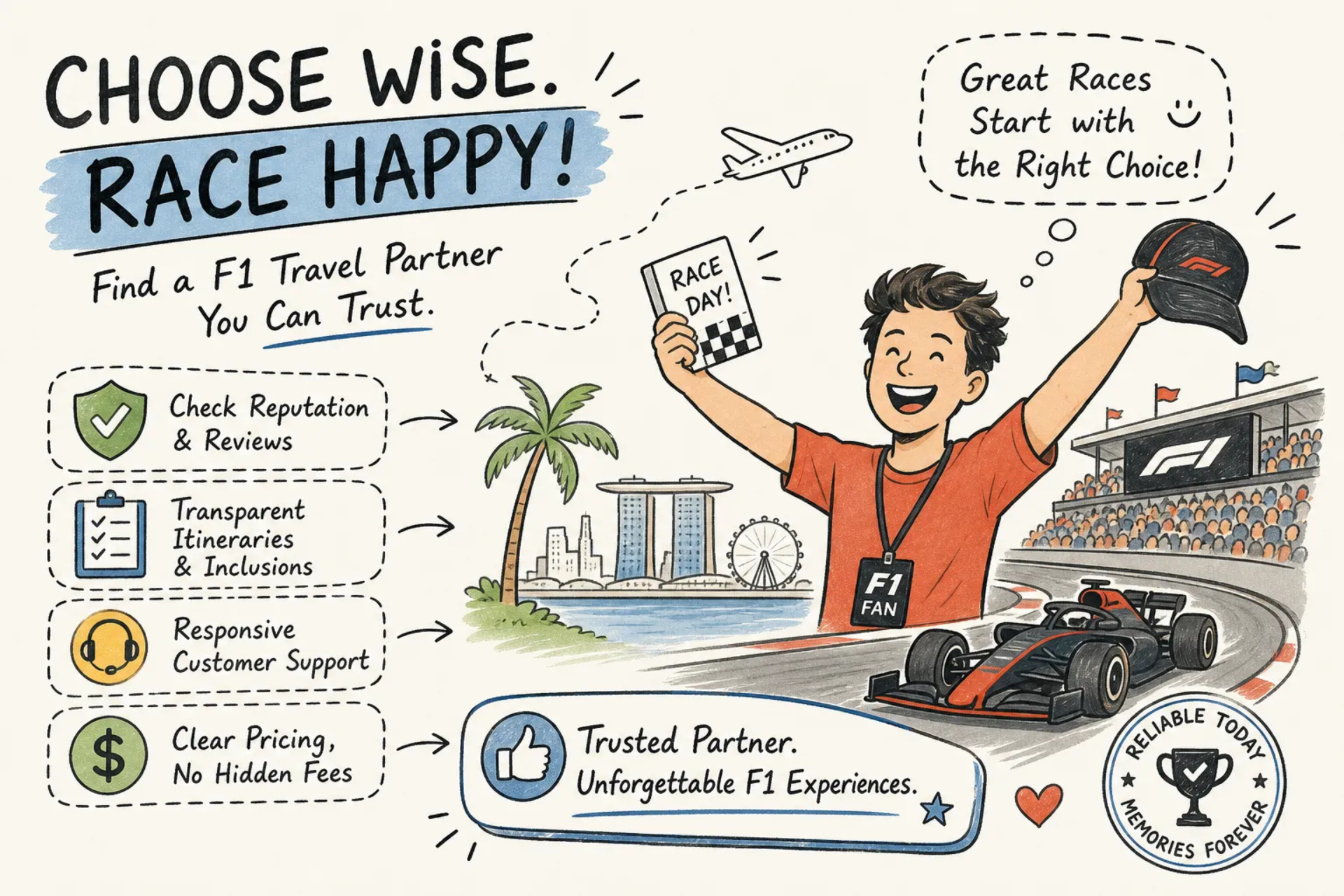
Finding reputable Formula 1 travel package companies is less about luck and more about applying a consistent set of criteria to every option on your shortlist. Verify ATOL protection directly with the CAA. Check for ABTA membership as a secondary signal of credibility. Scrutinise package listings for specificity on tickets, accommodation, and transfers. Read reviews critically, focusing on patterns around accuracy and complaint resolution. Put direct questions to any operator before committing, and read cancellation terms before you pay rather than after.
The operators who stand up to this scrutiny, verified credentials, transparent package details, a clear record of satisfied customers, are the ones worth booking with. The ones who cannot answer straightforward questions about their own packages are telling you something important about how your trip might unfold. This is not a market where price alone should be the deciding factor. The financial cost of booking with an unreliable operator, let alone a ruined race weekend, is almost always higher than whatever was saved at checkout.
At Skylord Cruise and Holidays, sport and events packages are built around exactly this framework, verified supplier relationships, transparent inclusions, and end-to-end logistics managed on your behalf. Skylord holds the relevant industry accreditations and works with confirmed suppliers, so the due diligence described in this guide has already been done for you. If the idea of spending hours interrogating operators and cross-referencing ATOL registers does not appeal, get in touch with the Skylord team to discuss the race weekend you have in mind.