
How to Plan a Multi Centre Holiday in Italy
How to Plan a Multi Centre Holiday in Italy
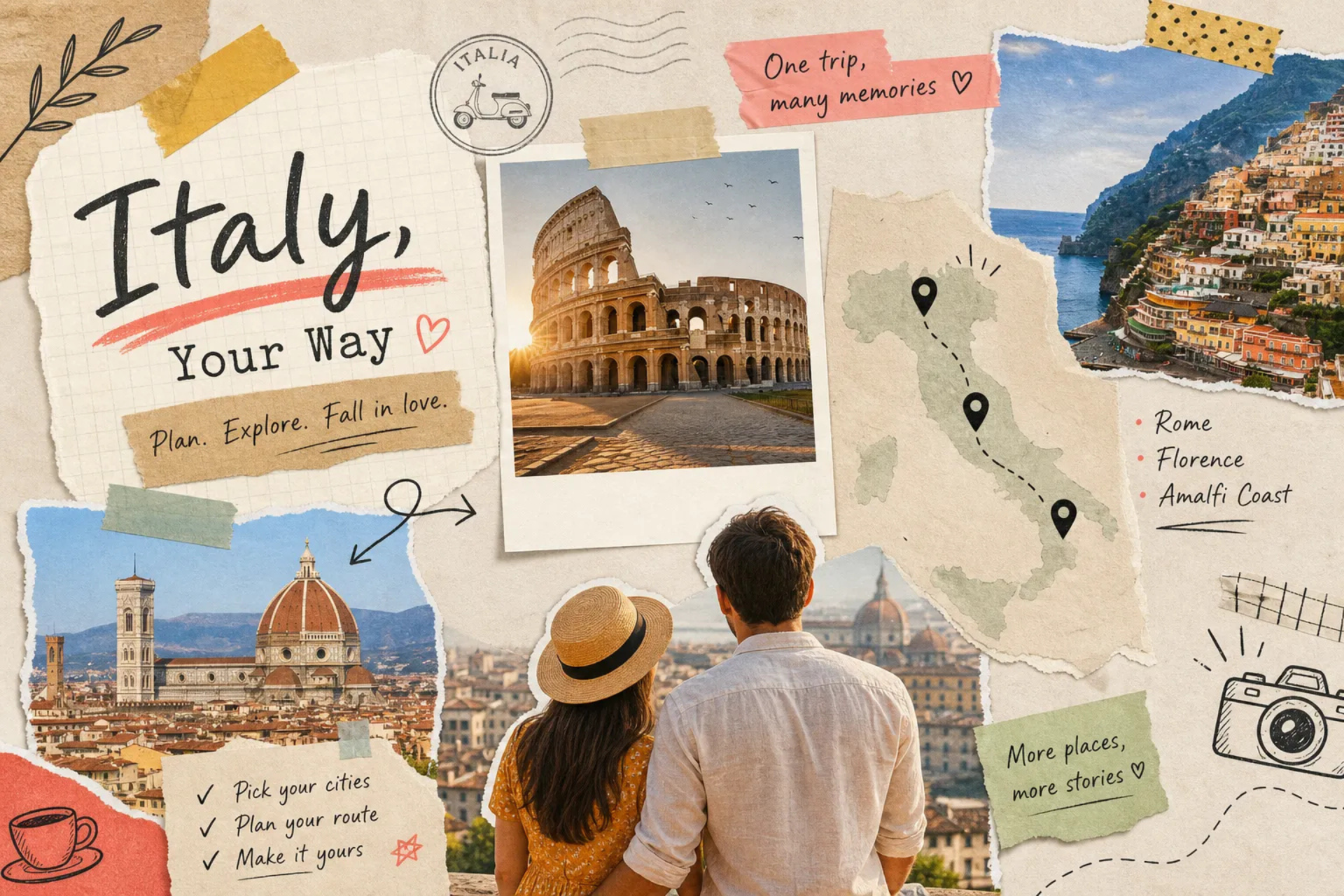
A multi centre holiday in Italy offers something that no single-city trip can replicate: the chance to move through entirely distinct civilisations that happen to share a border, each with its own dialect, cuisine, architectural logic, and emotional register. Yet there is a persistent paradox at the heart of Italian travel. Italy ranks among the world's most revisited destinations, yet it is also one of the most consistently mishandled. Travellers anchor themselves to one city, spend a week there, and leave with a nagging sense that something essential went unseen. The reason is straightforward: Rome, Florence, Venice, and the Amalfi Coast are not interchangeable chapters of the same story.
Planning a multi centre holiday in Italy acknowledges that the country cannot be understood from a single vantage point, any more than you could understand a symphony by listening to one instrument. The complexity of stitching these stops together is precisely why many travellers either underprepare or hand the task to a specialist. At Skylord Cruise and Holidays, our tailor-made Italy multi-stop packages are built around this precise challenge, removing the planning workload from what should be a purely exhilarating process. This guide covers everything you need: the best routes, how long to stay where, how to move between cities, when to go, and what the whole thing will realistically cost.
Planning a Multi Centre Holiday in Italy: Why One City Will Never Be Enough
Italy stretches over a thousand kilometres from the Alps to Sicily. Its regions are culturally, architecturally, and climatically distinct in ways that no single-base holiday can capture. A week in Rome immerses you in the ancient world: the Colosseum, the Forum, the Vatican's overwhelming accumulation of two millennia of Catholic power. A week in Florence gives you the Renaissance: Botticelli, Michelangelo, the Uffizi, and the hills of Chianti just beyond the city walls. A week on the Amalfi Coast gives you la dolce vita in its rawest form, lemon groves cascading down cliffs above waters of an almost implausible blue.
These are not variations on a theme. They are completely different experiences, separated not just by distance but by centuries of independent culture. The geography makes this point forcefully: Rome to Venice is a journey of roughly four hours by high-speed train; Naples to Venice takes closer to five and a half. Day-tripping between these regions is not merely inconvenient; it is genuinely impractical for most combinations. Moving bases is the only logical strategy, and, once you accept that, the whole trip opens up.
What single-centre travellers consistently report missing
The pattern is remarkably consistent among travellers who reflect honestly on their Italy trips. Those who based themselves in Rome for a week and never reached Tuscany, or who spent five nights in Florence and never made it to the coast, share a consistent regret. It is not about failing to do enough within a single city; it is about not structuring the trip to move at all. Building movement into the architecture of the holiday eliminates this regret entirely, because the itinerary itself becomes the experience.
The Most Popular Routes for a Multi Centre Holiday in Italy
The right Italy itinerary is not the most impressive-sounding one on paper. It is the one that matches your travel priorities: culture or coast, north or south, cities or countryside. Think of the following routes as frameworks, not prescriptions.
The classic northern triangle: Rome, Florence, and Venice
The Rome, Florence, Venice route is the most widely recommended starting point for first-time multi-stop travellers, and it works beautifully over seven to ten nights. The sequence runs logically south to north by high-speed train, with each city offering a completely different experience. A ten-day version can incorporate Cinque Terre between Florence and Venice, adding a stretch of dramatic Ligurian coastline to what would otherwise be a purely urban itinerary. This route suits travellers whose primary interest is history, art, and architecture, with the northern lakes available as an extension for those with more time. For travellers wanting to combine Venice with Lake Garda, consider Skylord's Luxury Venice & Lake Garda Holiday, Best of Both.
The southern coastal circuit: Naples, Sorrento, Amalfi, and Capri
For travellers drawn more to coastline than Renaissance galleries, the southern arc is the more compelling choice. The Rome, Sorrento, Capri route works well over eleven nights, beginning with Rome's ancient grandeur before heading south to the ferry-linked glamour of Capri and the slower pleasures of Sorrento. This circuit requires a different transport mindset: high-speed trains to Naples, then a combination of ferries and buses for the coastal legs. Driving is an option on the Amalfi Coast, but the roads are narrow, the traffic is dense, and the scenery demands your full attention rather than your hands on a steering wheel. For practical information on getting between Naples and the Amalfi Coast, see the Rome2rio overview of Naples to Amalfi Coast connections.
Extended itineraries for those who want both north and south
A fortnight allows you to combine both circuits: Rome, Florence, Venice, Siena, and Amalfi across thirteen to fourteen nights. These itineraries reward careful pacing. The risk is treating Italy like a checklist, moving so quickly between stops that you never settle into the rhythm of any single place. The solution is to resist the temptation to add one more city and instead give each destination the time it deserves. If you plan to rely heavily on rail for longer legs, resources on planning a rail trip in Europe can help you map sensible connections and realistic transit times.
How Many Nights to Give Each Stop
This is one of the most underestimated decisions in Italy planning. Too few nights and you leave exhausted; too many in a single place without the local knowledge to fill unstructured time and the days can feel directionless.
City stops: Rome, Florence, and Venice
Three nights in Rome allows you to cover the Colosseum and Roman Forum, a morning at the Vatican, and still have an evening in Trastevere without feeling rushed. Three nights in Florence is similarly well-calibrated: the Uffizi, Mercato Centrale, and a day trip to Siena or the Chianti countryside all fit comfortably. Venice, by contrast, rewards two nights rather than three. St. Mark's Basilica, the Grand Canal, and a morning on Murano fill the time well, and Venice's particular magic is intense rather than expansive. A third night rarely adds proportional value.
Coastal and countryside stops: Amalfi, Sorrento, and Cinque Terre
Coastal stops operate by a different logic. The Amalfi and Sorrento area rewards five to seven nights precisely because the best experiences unfold slowly: a day trip to Pompeii, a ferry to Capri, an afternoon in Positano, a morning watching fishing boats leave the harbour before the tourists arrive. Cinque Terre needs a minimum of two nights as a standalone stop, both for the hiking between villages and for the particular late-evening atmosphere when the day visitors have left. Coastal Italy is not a place to rush through; it is a place to inhabit, however briefly.
Best Transport for a Multi Centre Holiday in Italy
The logistics of a multi-stop Italy trip look simple on a map and feel complicated in practice, particularly once the Amalfi Coast or Cinque Terre enters the picture. Understanding the transport options clearly before you book makes the difference between a smooth trip and a frustrating one.
High-speed trains: the backbone of any Italian multi-stop trip
Frecciarossa and Italo services connect Rome, Florence, Venice, and Naples with a speed and efficiency that makes internal flights generally unnecessary for these city-to-city routes. Rome to Florence takes ninety minutes from roughly £17 per person booked well in advance; Florence to Venice takes around two and a half hours. Book train tickets around three months before travel when fares first open, because last-minute prices can rise steeply and the cheapest fare classes sell out quickly. The booking window for both operators typically opens ninety to one hundred and twenty days before departure, so set a reminder and book the moment the schedule becomes available.
When hiring a car makes sense and when it doesn't
There are exactly two situations in a classic Italy multi-stop itinerary where hiring a car earns its cost: the Amalfi Coast and the Tuscan countryside. Everywhere else, the train is faster, cheaper, and far less stressful. Venice has no cars at all; Florence's historic centre is a restricted traffic zone; and Rome's driving conditions are better observed from a pavement café than navigated from behind a wheel. The most practical approach is a hybrid strategy: trains between major cities, a car hired specifically for coastal or rural legs where public transport becomes indirect or infrequent.
What to book in advance and what to leave flexible
Pre-book the structural elements of the trip: high-speed train tickets as soon as the booking window opens, the Vatican Museums and Sistine Chapel, the Uffizi Gallery, and the Colosseum. These sell out weeks in advance during peak periods, and arriving without a reservation means spending your morning in a queue rather than inside. Accommodation in Venice and on the Amalfi Coast during May and June should also be secured early, as availability tightens fast. Leave day trips and restaurant bookings more flexible; weather and pace always shift once you arrive, and the best meals in Italy are often found by walking rather than planning.
Timing Your Multi Centre Holiday in Italy: The Months That Change Everything
Timing a multi-stop Italy itinerary is not a single decision because different regions peak and trough at different points of the year. A month that works brilliantly in Tuscany can be punishing on the Amalfi Coast, and the crowd patterns in Venice have shifted significantly in recent years.
May and early June represent the strongest window for a balanced multi-destination trip. Temperatures are comfortable across all regions, the landscapes are green and flowering, and tourist volumes have not yet reached summer saturation. Early October offers a similar balance, with harvest season adding a cultural dimension in Tuscany and Umbria that simply does not exist at any other time of year. For more on seasonality and optimal travel months, consult Rick Steves' advice on the best time to go to Italy.
Specific cautions are worth noting. July and August on the Amalfi Coast are extremely crowded and hot; the roads become gridlocked and the ferry queues stretch long before midday. September and October in Venice now tend to be busier and more expensive than midsummer, driven by honeymoon season, major cultural events, and European city-break demand. July through August in Florence brings uncomfortable heat and packed museums. February has the fewest crowds nationwide but the worst weather across the entire country, particularly in the north. For most travellers, May remains the single best month to move through Italy with both comfort and clarity.
What It Actually Costs, and How to Put the Whole Trip Together
Grounding the planning process in realistic numbers is essential before any booking begins. A seven-night mid-range multi centre holiday in Italy, excluding international flights, runs approximately £800 to £1,200 per person. A ten-night itinerary costs between £1,100 and £1,700; a fourteen-night trip reaches £2,100 to £3,200 per person. Budget travel compresses these figures to roughly £55 to £80 per person per day by prioritising two-star accommodation, self-catering lunches, and regional rather than high-speed trains where the time saving is modest. Premium itineraries with five-star hotels, private guides, and fine dining push well above £400 per person per day and reward early booking even more than mid-range travel does.
Building a multi centre holiday in Italy yourself is entirely possible if you enjoy the research process. Co-ordinating train reservations, hotel sequencing, museum pre-bookings, car hire handovers, and ferry connections adds up to a considerable time investment. Getting the logistics wrong mid-trip is also more disruptive than it would be on a single-centre holiday. For travellers who want the experience without the planning workload, working with a specialist removes that friction entirely. At Skylord Cruise and Holidays, our tailor-made Italy packages are built around your chosen route, travel style, and budget, handling the end-to-end logistics so the trip itself feels effortless rather than managed. For example, see the approach used in our Skylord Cruise and Holidays, Luxury Naples & Ischia, Italian Twin Centre Tour.
Start with the Route and Build Everything Else from There
Italy's complexity is not a problem to be solved; it is the point. The country rewards travellers who take it seriously enough to move through it deliberately, giving each stop the time it deserves rather than treating the whole peninsula as a single destination to be processed in one visit. Whether you follow the Rome, Florence, Venice triangle, explore the southern coast between Sorrento and Capri, or combine both in a fortnight-long journey, a well-planned multi centre holiday in Italy starts with committing to a clear route and booking the moving parts well before you travel. The train tickets, the museum slots, the hotels in Venice during May: these fill faster than most people expect, and the best options go first. Start with the route that matches your time and curiosity. Everything else builds naturally from that single decision. If you prefer a slower, historically focused itinerary that pairs lakeside tranquillity with Venetian exploration, consider the Italian Twin Centre Tours as an example of that style of journey.