Hrvatska Croatia: The Ultimate UK Travel Guide
Hrvatska Croatia: The Ultimate UK Travel Guide

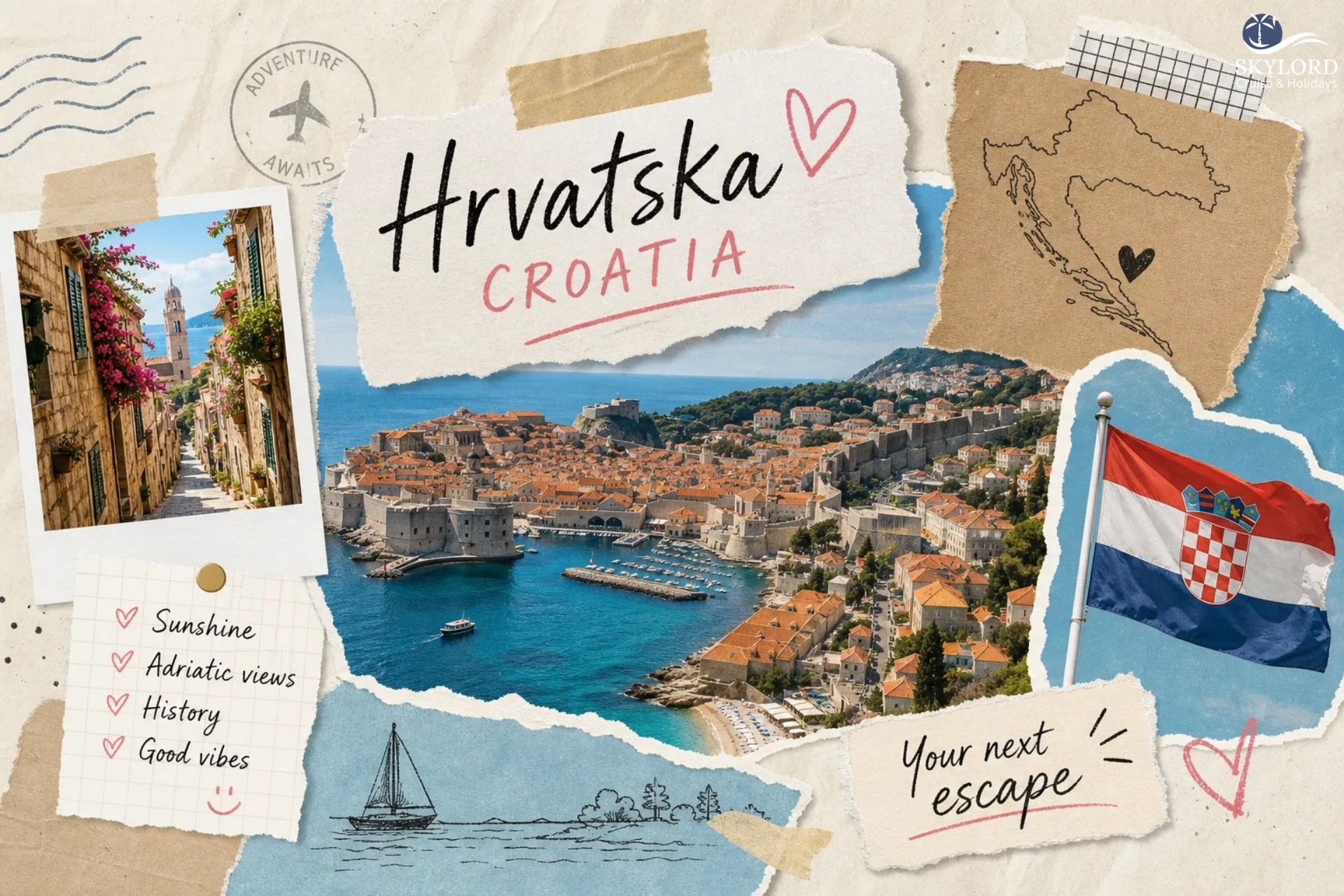
Picture the moment you spot "Hrvatska" printed across a car registration plate or stamped inside a passport and feel that flicker of confusion. Many first-time visitors book a holiday to Croatia without stopping to wonder why the country calls itself something entirely different in its own language. At Skylord Cruise and Holidays, we often hear from clients planning their first Adriatic trip: "What exactly is Hrvatska, and is it the same place?" The answer unlocks far more than a linguistics lesson. Understanding the dual identity of this country, its geography, its culture, and the richness packed into each of its regions, turns a sun-and-sea holiday into something with real depth. This guide moves from the name itself through the key facts, the sights worth knowing about, and the practical details every UK traveller needs before building an itinerary.
Hrvatska vs Croatia: why does this country carry two names?
The answer sits at the intersection of Slavic linguistics, medieval Latin scholarship, and centuries of European political geography. Far from being two competing identities, the two names are simply the same word dressed in different linguistic clothing.
The native name and what it actually means
Hrvatska is the Croatian name for the country, formed from the ethnonym Hrvat , meaning "Croat," combined with the Slavic place-forming suffix -ska, which gives it the meaning of "land of the Croats." The deeper root of Hrvat is still debated among etymologists. The most widely cited theory links it to an Iranian or Sarmatian origin, carrying a meaning close to "guardian" or "protector." No firm consensus exists, but the name is ancient, pre-dating the modern nation-state by many centuries.
How the Latin rendering reached the English language
When medieval scholars and diplomats needed a standardised written form for the country's name in Western European documents, they reached for Latin. The form "Croatia" emerged as the Latinised version of the South Slavic name, built from the same Hrvat root. It then passed into Western European languages, including English, as a direct borrowing from that Latin convention. Croatia is not a separate, independent name; it is simply the Western world's Latin-derived pronunciation of Hrvatska. Both names describe the same Republic of Croatia, the same capital Zagreb, and the same Adriatic coastline.
How to pronounce Hrvatska without embarrassing yourself at the airport
Knowing how the country pronounces its own name is a small act of respect that locals notice. The standard Croatian pronunciation is rendered in IPA as /ˈxr̩ʋatska/, which looks more alarming than it sounds, and becomes far more manageable when broken into parts.
Breaking the sounds down for an English speaker
The opening "Hr-" combines a breathy, slightly aspirated H with an immediately following rolled or trilled R; think of the R as carrying its own mini-syllable rather than simply following a vowel. The "-vat-" portion sounds like "vaht," with a short A. The closing "-ska" is crisp and rhymes roughly with "ska" as in the music genre. Strung together, aim for approximately "Hr-VAHTS-kah," with the stress falling on the first syllable. Forvo carries native-speaker recordings of Hrvatska, and several guides on YouTube walk through the pronunciation step by step if you want to hear it before you arrive.
Beyond Hrvatska itself, a small handful of Croatian phrases signals real curiosity to locals. "Hvala" (HVAH-lah) means thank you. "Molim" (MOH-leem) means please, and can also mean "you're welcome" depending on context. "Dobar dan" (DOH-bar dan) is a simple good day greeting. Croatian is phonetically consistent: once you know how each letter sounds, you can read out any word on a menu or sign, which makes it unusually approachable compared to languages with irregular spellings.
Key facts about the Republic of Croatia every UK visitor should know
A handful of core facts shape every practical decision, from budget to border crossing. Getting these straight early removes a surprising number of complications.
Capital, population, language, and currency
Zagreb is the capital and largest city, a continental European metropolis that most coast-focused travellers bypass entirely at their peril. The country's population stands at approximately 3.84 million, as recorded in the 2021 census published by the Croatian Bureau of Statistics, spread across an area of 56,594 square kilometres. Croatian is the sole official language. Croatia adopted the euro in January 2023, which removes the currency exchange complication that once caught UK visitors off guard; you can use the same euros you might carry in France or Spain without any additional conversion step.
What EU and Schengen membership means for UK travellers post-Brexit
Croatia has been a full EU member since 2013 and joined the Schengen Area in January 2023. For UK passport holders travelling after Brexit, this matters practically: your 90-day-in-180-day Schengen allowance applies here just as it does across the rest of the zone. If Croatia forms part of a broader European multi-centre trip, track your Schengen days carefully from the outset. The European Travel Information and Authorisation System (ETIAS) is expected to launch in autumn 2026; once operational, it will require a pre-travel registration and a €20 fee for UK citizens entering Schengen countries. No action is needed until the system goes live, but check the UK Government's Croatia travel advice page (gov.uk) before finalising any booking.
The regions and sights that make Croatia one of Europe's most rewarding destinations
Croatia rewards travellers who see it as more than a single destination. The country contains striking geographic variety within a relatively compact footprint, which makes it ideal for a multi-centre itinerary that moves between very different landscapes and cultures within a single trip.
The Dalmatian Coast: Dubrovnik, Split, and the Adriatic islands
Dubrovnik is Croatia's most famous city, and its reputation is entirely deserved. The medieval Old Town, enclosed within intact stone walls, is a UNESCO World Heritage Site and one of the best-preserved historic urban centres in the Mediterranean. Split, roughly two hours north by road or ferry, centres on Diocletian's Palace, a Roman emperor's retirement complex that an entire modern city has grown up inside over seventeen centuries. The Dalmatian islands, including Hvar, Korčula, Brač, and Vis, are the gateway to Croatia's island-hopping culture. Whitewashed towns, clear Adriatic water, sailing routes, and a pace of life markedly slower than the mainland cities make them a draw in their own right.
Plitvice Lakes, Istria, Zagreb, and the inland counterpoint
Sixteen terraced lakes connected by waterfalls and turquoise channels threading through forested hills make Plitvice Lakes National Park Croatia's most celebrated natural landmark. Situated inland between Zagreb and the Dalmatian Coast, it is a natural addition to any multi-stop Croatian itinerary. May delivers the strongest waterfall flow with significantly lighter crowds than the peak summer months, making it the ideal window for a visit. Istria, the triangular peninsula in the north-west, offers a completely different flavour: Venetian-influenced hilltop towns, truffle-rich cuisine, and a wine culture that has attracted serious food travellers for years. Zagreb itself rewards a day or two with its Austro-Hungarian architecture, world-class museums, and a café culture that feels more Vienna than Adriatic.
The best time to visit Croatia and how to plan a smarter itinerary
Croatia's climate divides cleanly along geographic lines. The Dalmatian Coast and islands follow a Mediterranean pattern, hot, dry summers and mild, wetter winters, while inland Croatia operates on a continental schedule, with hotter summer extremes, colder winters, and distinct spring and autumn seasons. Matching your travel dates to the region you are prioritising makes a measurable difference to the experience.
For the coast and islands, May, June, and September deliver warm enough temperatures for comfortable swimming, far less congestion than July and August, and noticeably lower prices for accommodation. Dubrovnik in particular becomes intensely busy in peak summer; visiting in late May or early October transforms the atmosphere entirely. July and August remain the right choice if guaranteed warmth and the liveliest beach scene are the priority, but book well in advance and expect the most popular ferry routes, particularly Split to Hvar, to fill quickly.
A commonly recommended multi-centre Croatian itinerary opens in Zagreb, moves south to Plitvice Lakes, then continues to Split and the Dalmatian Coast before finishing in Dubrovnik. This routing follows the country's main transport links and works well logistically. Combining these stops independently involves coordinating ferries, buses, hire cars, and accommodation across multiple islands and cities. This is precisely the kind of complex, layered itinerary that Skylord Cruise and Holidays builds as a tailor-made package for UK travellers, handling every connection so you focus on the experience rather than the logistics.
Practical travel signposts for UK visitors planning a Croatian trip
A few final details make the difference between a smooth trip and an avoidable complication. Getting these sorted before departure, rather than at the airport or on the ferry dock, removes most of the stress from the planning process.
Multiple UK airports serve Croatia directly through the summer season, with scheduled flights landing in Dubrovnik, Split, Zadar, and Zagreb from London, Manchester, Birmingham, Edinburgh, Glasgow, Bristol, and several other departure points. Based on current airline schedules, Dubrovnik is the best-served Croatian destination for direct UK routes, with the widest spread of airlines and airports available. Hiring a car gives the most flexibility for inland areas and Istria, though it is largely unnecessary on the Dalmatian islands, where walking and local boats cover most ground.
Jadrolinija and other ferry operators run scheduled passenger services between the mainland and the major islands. Booking catamarans in advance during peak season is strongly advisable on popular routes such as Split to Hvar and Hvar to Korčula, where spaces on busy sailings do sell out in July and August, so planning ahead is well worth the effort.
UK travellers should carry a valid UK Global Health Insurance Card (GHIC), which covers necessary healthcare in Croatia as an EU country, full guidance on coverage and limitations is available on the NHS GHIC page and the UK Government's Croatia travel advice page. Travel insurance covering cancellations, medical evacuation, and activity-specific situations such as sailing or hiking at Plitvice Lakes is strongly advisable. The Croatian National Tourist Board (croatia.hr) and the UK Government's Croatia travel advice page (gov.uk) are the authoritative sources for up-to-date entry requirements, safety information, and regional travel updates.
The two names, one extraordinary country
Hrvatska and Croatia are the same place wearing two names: one native and ancient, the other borrowed through centuries of Latin scholarship. Understanding both is a small act that connects you to the country before you even arrive. Whether you are drawn by the walled cities of the Dalmatian Coast, the cascading lakes of the interior, or the layered Roman history of Split, Croatia rewards travellers who approach it with an honest curiosity rather than a single-destination mindset.
The country is built for a multi-centre adventure, and the research, ferry bookings, and region-by-region itinerary planning that go with it need not be complicated. At Skylord Cruise and Holidays, we put together tailor-made multi-centre Croatia packages for UK travellers, taking every logistical piece off the table so you can focus entirely on discovering what Hrvatska truly means. Get in touch with our team, we would be glad to start building your Croatian itinerary around the regions and experiences that matter most to you.