
MSC Ships Guide: Which MSC Cruise Ship Is Right for You?
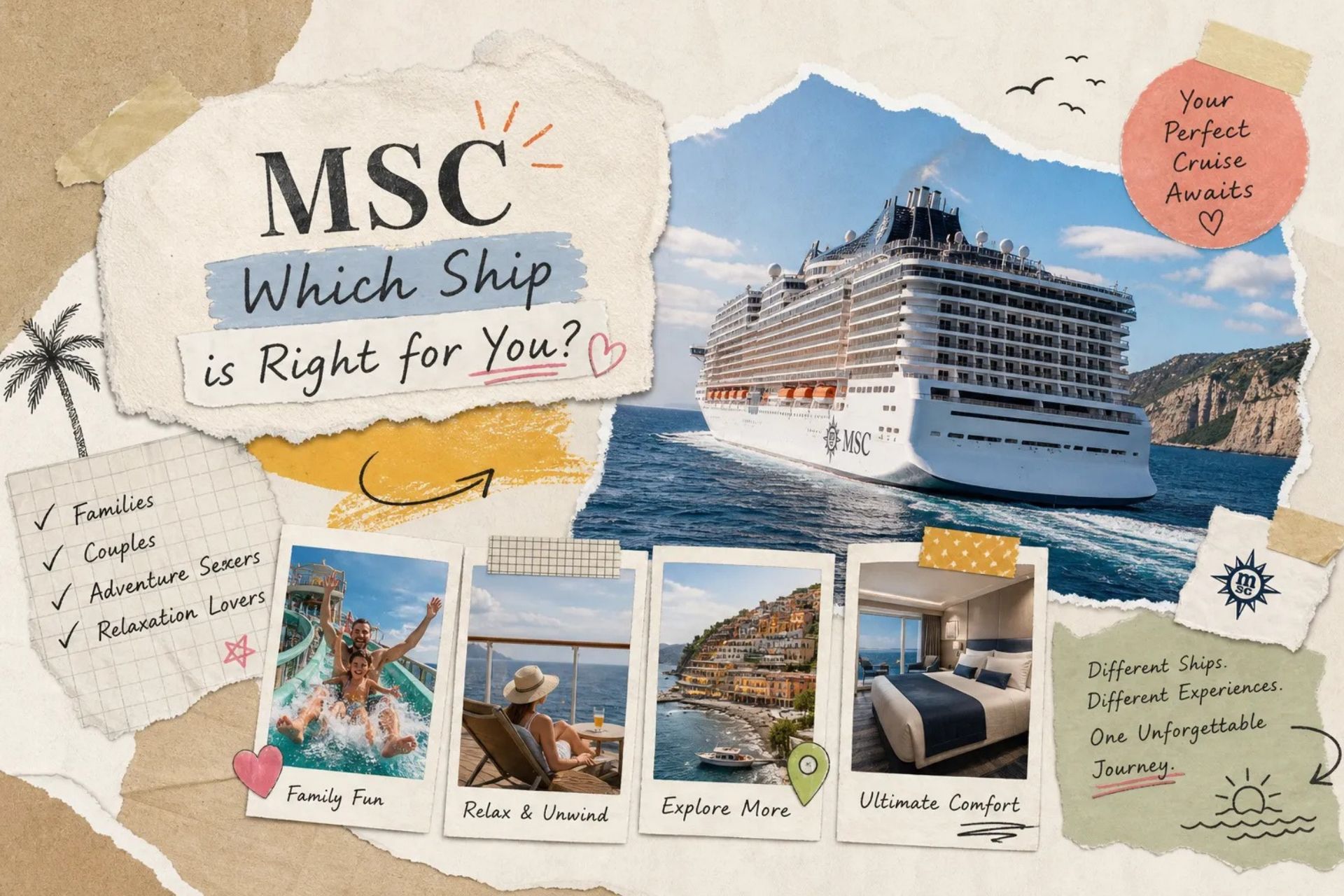
MSC Ships Guide: Which MSC Cruise Ship Is Right for You?

Choosing between MSC ships can feel overwhelming when you're staring at 24 vessels spanning eight distinct classes and 25 years of shipbuilding evolution. The fleet stretches from the Caribbean to the Norwegian Fjords, and for most travellers, the sheer scale of options is enough to bring a booking to a standstill before it even begins.
The problem is not a lack of choice. The problem is choosing without a framework. At Skylord Cruise and Holidays, matching clients to the right MSC vessel is one of the most satisfying conversations the team has every week, because once you understand how the fleet is structured, the decision becomes surprisingly clear. This guide gives you that structure: a practical mental model for navigating every ship in the fleet and landing on the one that actually suits the way you travel.
The MSC fleet in 2026: 24 ships across eight classes
The first thing to understand is that the fleet is not a random collection of ships. It is organised into eight distinct classes, each representing a generation of design thinking: Lirica, Musica, Fantasia, Seaside, Seaside EVO, Meraviglia, Meraviglia-Plus, and World. Think of them as a ladder of evolution, from the intimate, classic vessels of the early 2000s to the vast, district-based megaships of today. Where a ship sits on that ladder tells you a great deal about what life on board will feel like, the size and gross tonnage, the family amenities, the entertainment density, the cabin variety, and the likely itineraries.
MSC Armonia entered service in 2001, while MSC World America arrived in 2025. MSC World Asia is scheduled to join the fleet as the latest World class vessel, powered by LNG and organised around the same thematic district layout as its sister ships. (Note: the confirmed entry-into-service date is subject to final scheduling confirmation from MSC Cruises, check directly for the latest updates.) The gap between the oldest and newest vessels in this fleet is not merely cosmetic; it represents 25 years of shipbuilding ambition, and it is genuinely significant for anyone making a booking decision.
What each MSC ship class actually means for your holiday
A ship class is more than a size band, it is a design philosophy that shapes the entire character of your time on board. Here is how each generation differs in practice.
Classic-era ships: Lirica and Musica
The Lirica class vessels, MSC Armonia, Sinfonia, Lirica, and Opera, are the most traditional in the fleet. Smaller and more destination-focused, they carry between 2,500 and 2,700 passengers and offer four restaurants, multiple pools including a children's pool with slides, and mini-golf. The Musica class, comprising MSC Musica, Orchestra, Poesia, and Magnifica, is slightly larger at around 92,000 to 95,000 gross tonnes, with three pools and a relaxed, classic cruising feel. Neither class was built to compete with a land-based theme park. They suit travellers who want the ship to be a comfortable backdrop while the ports of call carry the story.
The transition generation: Fantasia and Seaside
The Fantasia class changed MSC's ambition considerably. MSC Fantasia, Splendida, Divina, and Preziosa introduced bowling alleys, the Aurea Spa, proper theatres, sports arenas, and multiple pools to the experience. These ships, ranging from 137,000 to 139,000 gross tonnes, marked a deliberate move toward vessels that compete with land-based resort holidays rather than simply sailing between ports. The Seaside class then pivoted the design focus entirely outdoors: MSC Seaside and MSC Seaview were built around a waterfront promenade, open decks, and strong sea views. The Seaside EVO ships, Seashore and Seascape, both at 170,412 gross tonnes, refined this further with aqua parks, dedicated show lounges, and luxury suite upgrades.
Entertainment-first: Meraviglia and Meraviglia-Plus
The Meraviglia class ships, including MSC Meraviglia, Bellissima, and the Meraviglia-Plus vessels Grandiosa, Virtuosa, and Euribia, anchor their entire identity in a long indoor promenade lined with restaurants, bars, and entertainment venues. At 171,000 to 181,000 gross tonnes, these are genuinely large ships built for families and groups who want structured entertainment, robust kids' clubs, and round-the-clock programming. The indoor-focused layout also makes them well-suited to itineraries where the weather is unpredictable, such as Northern European sailings, where the outdoor deck lifestyle of a Seaside ship may be less appealing.
The flagship MSC ships defining the next chapter
The World class vessels represent the clearest statement of where the line is heading, and they deliver the largest, most complex onboard experience in the entire fleet. MSC World Europa, which entered service in 2022, comes in at 215,863 gross tonnes and 333 metres in length, carrying 6,762 passengers across 2,760 cabins. MSC World America, which arrived in 2025, is slightly larger at 216,638 gross tonnes. To put those numbers in context: each World class ship is roughly three times the size of an older Lirica class vessel. Both are powered by LNG, making them among the most environmentally advanced vessels currently operating in the fleet.
What sets World class apart is not size alone; it is the district-based layout. Rather than organising the ship by deck, these vessels divide the space into distinct neighbourhoods: a family district with waterparks and structured children's entertainment, a zen adults-only district, entertainment zones, and multiple dining precincts. Two passengers on the same sailing can have entirely different holidays without ever crossing paths. MSC World America alternates seven-night Eastern and Western Caribbean itineraries from Miami, calling at Ocean Cay, Cozumel, Roatan, Puerto Plata, and San Juan. MSC World Asia, whose entry-into-service date is subject to final confirmation from MSC Cruises, will be the freshest ship in the fleet at launch, with its full itinerary programme taking shape closer to delivery.
MSC ships: cabins, deck plans, and accommodation choices
On older Lirica and Musica class ships, accommodation falls into four broad categories: inside, ocean view, balcony, and suite. The distinctions between subcategories are mainly about size and a handful of experience upgrades. This simplicity is not a disadvantage. For many travellers, fewer options mean a faster, less stressful booking decision, and the cabins themselves are perfectly comfortable for ships built in the classic cruising tradition.
On MSC World America, there are 19 distinct cabin types. These include owner's suites, duplex suites spanning two levels, connecting family cabins, promenade-view balcony cabins, and the Infinite Ocean View cabin, a genuinely novel concept where a sliding glass panel converts the window wall into an open glass balustrade. MSC Seashore adds terrace suites and multiple Yacht Club stateroom configurations. Reading a deck plan for these ships takes more time, but the reward is a cabin that is genuinely built around the way you want to spend your days at sea.
The Yacht Club deserves particular mention. Available across a wide range of ships in the fleet, including Fantasia, Meraviglia, Meraviglia-Plus, and World class vessels, among others, the Yacht Club operates as a private enclave within the ship: a dedicated pool, sundeck, restaurant, 24-hour butler service, premium drinks package, and Wi-Fi included. It functions as a five-star hotel within a mainstream cruise ship, and for travellers who want luxury without booking an exclusively premium line, it is often the most practical route to getting it.
Which MSC ships suit your style of travel
For families with children
World class and Meraviglia-Plus ships are the strongest choices. The district-based layout of MSC World Europa and World America delivers dedicated family zones that keep children entertained without pulling parents away from their own experience, while the indoor promenade on Meraviglia ships keeps activities accessible regardless of the weather. For UK families specifically, MSC Virtuosa sails from Southampton in 2026 on itineraries ranging from two to 14 nights, covering the Norwegian Fjords, the Canary Islands, and the Mediterranean. It is a genuine no-fly option, with sample routes including Southampton to Alesund, Olden, and Kristiansand, and a nine-night Iberian sailing calling at Lisbon, Gibraltar, Malaga, and Cadiz.
For couples seeking romance or relaxation
Seaside and Seaside EVO ships prioritise outdoor space, sea views, and a lifestyle-oriented atmosphere that suits couples more naturally than the entertainment-heavy Meraviglia class. The Yacht Club tier on any eligible ship transforms the experience entirely. For itineraries with a slower, more port-rich rhythm, MSC Lirica sailing the Eastern Mediterranean from Venice and MSC Sinfonia operating from Bari both offer destination-led programmes that treat the ship as a comfortable gateway rather than the main attraction.
For luxury and discerning travellers
The Yacht Club on MSC World Europa or MSC World America delivers the most premium experience in the fleet, combining the newest hardware with the full butler service model. For travellers who prefer a slightly quieter ship with a more refined atmosphere, the Fantasia class vessels, particularly MSC Splendida and MSC Divina, offer the Aurea Spa experience and a more considered pace at a lower price point than the World class ships. And for anyone drawn to sailing on something genuinely new, MSC World Asia's debut makes it a compelling fresh option in the fleet once it enters service.
Getting your MSC ship choice right the first time
Most travellers choose a destination first and a ship second. Time and again, our clients at Skylord Cruise and Holidays tell us that the onboard experience shapes their holiday satisfaction more than any port on the itinerary. The ship is not the vehicle. It is the destination.
The most common mistake cruise bookers make is choosing the cheapest available sailing without considering ship class, age, or deployment. In our experience, a traveller who boards an older Lirica class vessel expecting the waterpark and entertainment infrastructure of a World class ship will be disappointed, not because the Lirica ship is poor, but because it was built for an entirely different purpose. Class awareness is the single most valuable piece of knowledge a first-time cruiser can bring to the booking process.
A good cruise consultant does not simply book a cabin. They take in the full picture: the group dynamic, the travel dates, the budget, and the experience you are genuinely hoping to have. For a fleet of 24 ships across eight classes, that kind of expertise is not a luxury, it is the difference between a good holiday and exactly the right one.
The framework that makes 24 MSC ships navigable
The fleet is vast, but it is also organised. Eight classes and a clear progression from classic destination-led cruising to district-based megaships gives any traveller a navigable framework, provided they know how to read it. Class shapes the onboard character; ship age governs the cabin variety and technology on offer; and deployment dictates where and when you actually travel. Apply those three lenses to any sailing and the choice narrows quickly from overwhelming to obvious.
If you are still uncertain which of the MSC ships fits your particular mix of dates, budget, and travel style, a conversation with the team at Skylord Cruise and Holidays costs nothing and could save you from booking the wrong experience. Whether you are drawn to the intimate charm of the classic fleet or the sheer scale of the newest World class vessels, finding the right match is what we are here for.