
Teletext Holidays Then and Now: How UK Travel Has Changed
Teletext Holidays Then and Now: How UK Travel Has Changed

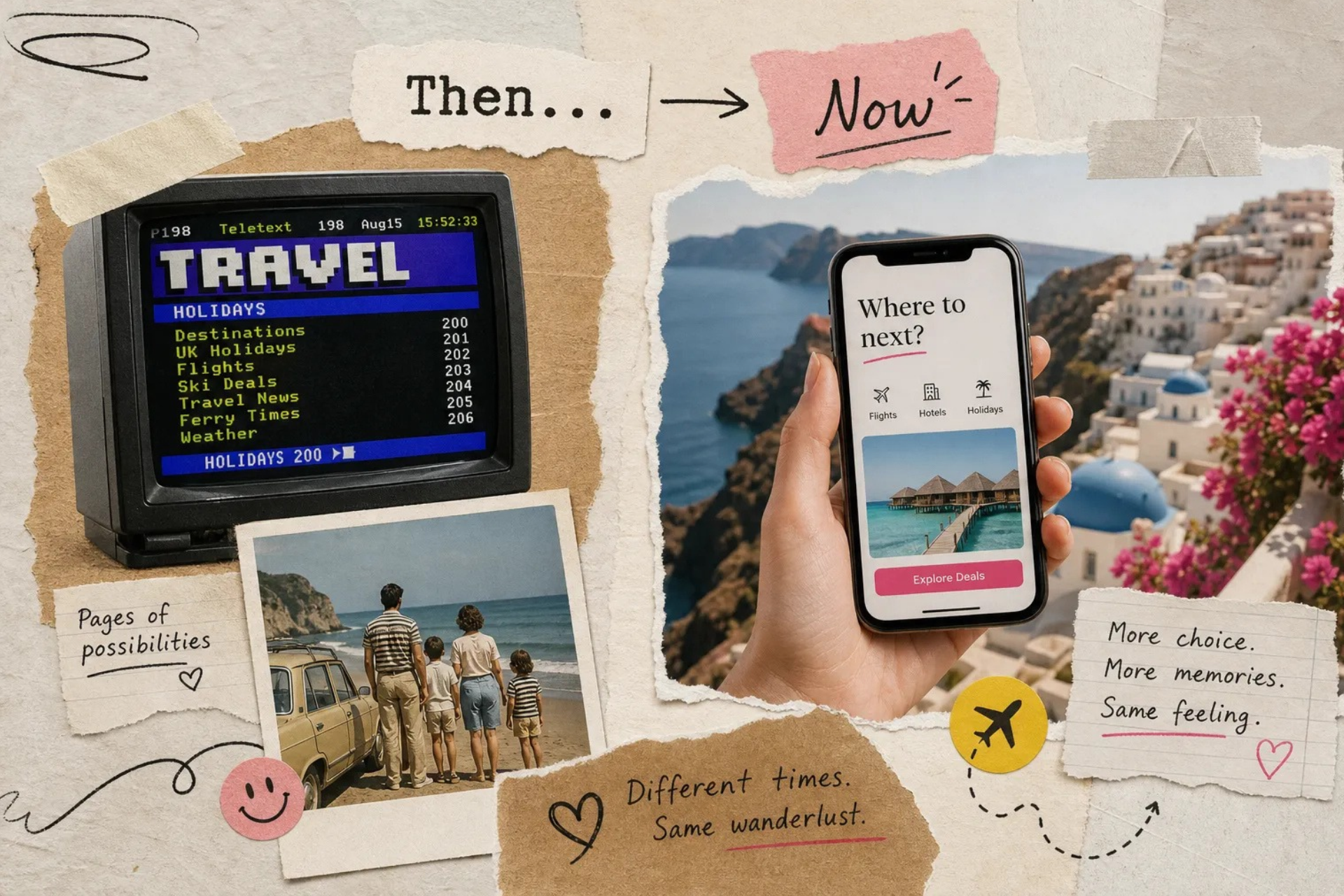
Picture a British living room, sometime in the early 1990s. The family has finished dinner. Someone reaches for the remote and flicks to Teletext Holidays page 200 on the television. The screen fills with rows of small text: hotel names, resort codes, departure airports, prices. A biro appears. There is urgency now, because the page will scroll before you've finished writing, and the deal to Majorca for £199 per person all-inclusive will be gone. You wait. It cycles back. You write faster.
That ritual was the entire holiday-booking experience for a generation of UK families. Teletext Holidays wasn't just a service; it was an event, a weekly hunt for something that felt genuinely discoverable. The name still carries something real: a sense that a bargain existed if you were patient and sharp enough to find it.
Decades on, the brand has resurfaced under new ownership. The world around it, however, has been transformed almost beyond recognition. Online platforms, ATOL certificates, Trustpilot scores, and low-deposit instalments have replaced the flickering screen.
The golden age of Teletext Holidays: how a flickering TV screen changed British holidays
The mechanics were surprisingly elegant for their era. Both BBC Ceefax and the ITV commercial teletext service broadcast text and simple graphics inside the unused vertical blanking interval of the television signal. A decoder in the set extracted the data and displayed numbered pages on demand. Pages weren't fetched instantly; they cycled continuously, so you waited for your page to come around again. The BBC grouped travel content in the 400s on Ceefax.
ITV's services, first ORACLE and then Teletext Ltd after ORACLE lost its licence in 1992, carried their own holiday directories. The result was a system that felt interactive without actually being so, and that slight friction made finding a deal feel like an achievement.
Before Teletext, booking a foreign holiday meant walking into a Thomas Cook or Lunn Poly branch and paying whatever price was printed in the brochure. There was no comparison, no sense of what the market looked like. Teletext broke that information monopoly. Prices were visible, deals were competitive, and a working family in Stoke or Swindon could suddenly see the same options as anyone else. For the first time, the cheap last-minute package holiday felt genuinely accessible to ordinary households, not just those who happened to know the right agent.
What happened to Teletext Holidays, and is it still running in 2026?
The road from that living room ritual to the present has not been smooth. The original company behind the brand was Truly Travel Ltd, trading as Teletext Holidays TV Limited. In 2021, following serious problems with pandemic-era refunds and intervention by the Competition and Markets Authority, the company entered voluntary liquidation in December of that year. It lost its ATOL licence and TTA membership. Existing bookings were transferred to TTA Travel, which honoured them under its own ATOL licence number T7173 where possible. For customers with outstanding refund claims, the TTA became the point of contact. It was a bruising episode for a brand many Britons had trusted for decades.
The story did not end there. In 2023, the intellectual property was purchased from the liquidators by a new business: Teletext Travel Ltd. The brand was relaunched under teletextholidays.co.uk in 2024, and as of 2026 the site is active, publishing deals and press updates. This is a new company using a revived name, not a continuation of the old one.
How UK holiday booking evolved from the TV screen to the algorithm
The internet didn't simply replace Teletext. It multiplied the number of options to a degree that created its own problems. Mintel data from the early 2000s shows the travel agent channel falling from 61% of UK bookings in 1999 to 49% in 2003, while internet booking rose from negligible levels to 11% in the same period. By 2009, package holidays' market share had dropped from 47% to 38%, before recovering slightly. The shift wasn't that Britons stopped taking package holidays; it was that they stopped buying them the same way.
Low-cost airlines, dynamic packaging, and price-comparison engines each promised the best deal. The result was more price transparency but far less clarity on what was actually being compared. On the Beach, for instance, currently advertises deposits from £19 per person on selected holidays, well below Teletext Holidays' published floor of £49 per person.
The promise of modern online booking is that you can find anything, compare everything, and pay only for what you need. In practice, most travellers end up overwhelmed and under-informed, booking something that looked right on screen but didn't account for the details that actually matter. Ship size, cabin location, itinerary layering, and transfer reliability are all variables that a filter dropdown cannot weigh for you, and neither can it tell you what happens if the airline changes the schedule four days before departure. The algorithm optimises for the click, not for the holiday.
What no search engine can give you: the case for a travel specialist
A price-comparison result can show you two cruises departing on the same date at similar costs. What it cannot tell you is which one suits the way you actually travel. Whether you want a large ship with entertainment for the family, a smaller vessel with a more intimate atmosphere, or an itinerary that layers a Caribbean cruise with a land stay in a destination most travellers simply fly over: that level of judgement requires human expertise, not a filter dropdown.
This is precisely where agencies like Skylord Cruise and Holidays offer something the Teletext screen never could. Skylord specialises in tailor-made cruise itineraries and multi-centre holiday packages, working through the full picture of what a traveller actually wants before a booking is made. A romantic itinerary for a honeymoon is built differently from a family-friendly multi-centre trip, which is built differently again from a group departure with coordinated logistics across multiple destinations. Each of those requires a real conversation.
- Tailor-made cruise itineraries designed around how you travel, not what fits the system
- Multi-centre holiday packages that combine destinations most travellers would need to book separately
- Sport and concert packages, group travel coordination, and end-to-end itinerary support
That kind of expertise doesn't show up on a comparison page. It shows up when your trip actually goes to plan: when the cabin is the right one, when the connection works, and when someone already knows the answer before you have to ask the question. Speaking directly with the Skylord Cruise and Holidays team costs nothing and can make an enormous difference to the holiday you end up taking.
What this all means for your next booking decision
The bigger story here is not really about one brand's survival. It is about what UK travellers have gained and lost in the shift from a flickering TV page to an infinite scroll of results. Convenience is real. Personal expertise is rarer than it has ever been. If you are planning something more than a return flight and a hotel room, that difference starts to matter enormously.
The best holidays have always been built on someone who genuinely knows what they are doing. That was true when your parents were scribbling down a deal to Majorca with a biro. It remains true now. We have simply, somewhere in the convenience of the algorithm, forgotten to ask for it.