
Best Time to Visit Sri Lanka: Month-by-Month Guide
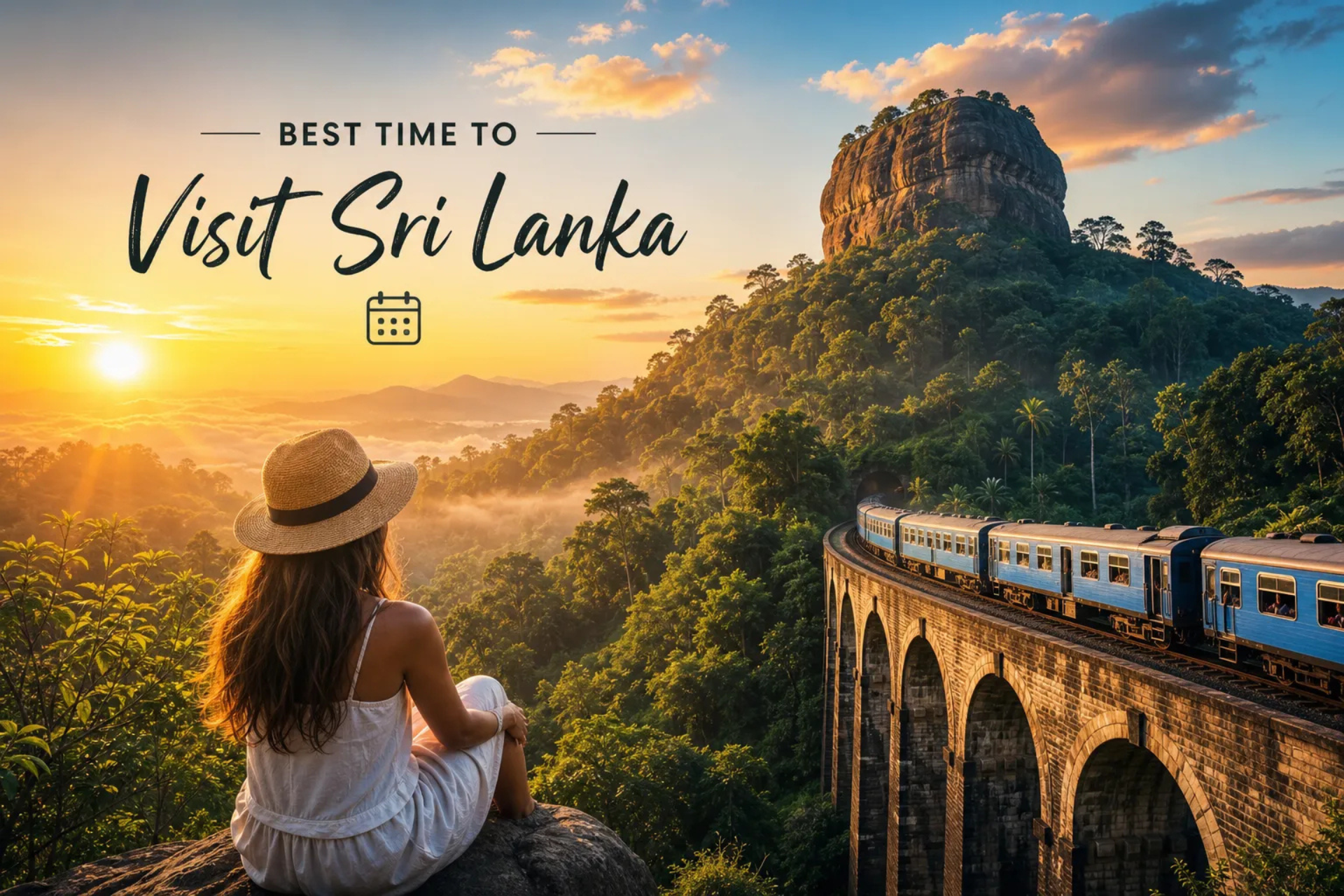
Best Time to Visit Sri Lanka: Month-by-Month Guide
Most travellers searching for the best time to visit Sri Lanka ask the same question: "When should I go?" It's an understandable question, but it's also the wrong one. The honest answer is that Sri Lanka operates on a dual monsoon system, meaning at least one coast is reliably drier than the other at any given time of year. What changes is where that sunshine falls, and understanding that distinction is the difference between a perfectly timed trip and a rain-soaked disappointment.
Sri Lanka's two entirely separate weather systems play out simultaneously on opposite sides of the island. The west coast can be lashed by June downpours while the east coast basks under cloudless skies. The highlands near Ella can be wrapped in mist while Trincomalee is bone dry. Once you understand this, the whole planning puzzle clicks into place.
This guide walks through the two monsoon windows, the best regional seasons for beaches, wildlife, and surfing, and how different travel priorities should shape your timing. It's exactly the kind of complexity that the team at Skylord Cruise and Holidays navigates for UK travellers building tailor-made multi-centre Sri Lanka itineraries, because getting the timing right across multiple regions is rarely straightforward on your own.
Why the best time to visit Sri Lanka isn't a single month
The single most important fact for planning any Sri Lanka visit is this: two distinct monsoons operate on a seasonal rhythm, and they affect opposite ends of the island. This isn't a minor meteorological footnote. It fundamentally changes which coast you visit and when.
The southwest monsoon (May to September)
Known locally as the Yala season, the southwest monsoon rolls in from May and drives heavy rainfall into Colombo, Galle, the south coast, and the hill country, with June seeing the heaviest falls. Colombo receives around 371mm of rainfall in May alone, compared to just 58, 71mm in January. The critical counterpoint, which most travellers miss entirely, is that this same period delivers the dry, sunny season to the east coast and the north.
The northeast monsoon (October to January)
The Maha season reverses the dynamic completely. From October through January, the east coast and northern regions bear the heaviest rainfall. Trincomalee sees over 350mm in both November and December. Meanwhile, the south and west coasts enter their driest, sunniest stretch, making Galle, Mirissa, and Unawatuna genuinely delightful from late November onwards.
The inter-monsoon windows
April and October/November sit between these two systems as transitional months. Short, scattered showers can appear island-wide during these periods, making the weather less predictable. They're not unworkable months by any means, and shoulder-season pricing makes them attractive for budget-conscious travellers, but you should go in with realistic expectations rather than banking on guaranteed sunshine.
Sri Lanka weather by month: the south and west coast's golden window (December to March)
For the majority of UK travellers, this is the section that matters most. The south and west coasts, including Colombo, Galle, Mirissa, and Unawatuna, are at their absolute best from December through March. The numbers make the case clearly: Colombo averages just 58, 71mm of rainfall in January versus over 370mm in May. The hill country follows the same dry rhythm, making this the period when the classic Sri Lanka circuit, coast, highlands, and culture, all aligns in your favour. For a clear month-by-month view of rainfall in Colombo, see the data on average monthly precipitation in Colombo here.
Beach season on the south coast
Mirissa, Unawatuna, and Tangalle come fully alive from December to early April. Calm seas, brilliant sunshine, and warm water temperatures make snorkelling and swimming genuinely enjoyable rather than an act of optimism. A useful comparison: conditions at Mirissa in January are settled and clear, with glassy mornings ideal for whale watching boats, whereas by late April the swell begins to build noticeably. The south coast stretches comfortably into April, though showers become more frequent as the month progresses and the build-up to the southwest monsoon becomes noticeable by late April.
Exploring the highlands in the dry window
Kandy, Ella, and Nuwara Eliya share this dry-season benefit. Nuwara Eliya stays cool year-round, with highs rarely exceeding 23°C, but February and March bring the least rainfall of the year. Tea plantation walks in the mist-free air and the legendary train journey between Ella and Kandy are particularly rewarding during this window. It's worth noting that Nuwara Eliya sees around 100mm in February, rising to 120mm in March, cool and refreshing rather than relentlessly wet.
April as a shoulder month
April deserves an honest framing. The south coast is still largely sunny, temperatures are warm, and the crowds that pack resorts between Christmas and March begin to thin out noticeably. For budget-conscious travellers, this matters: package holiday prices typically drop by around 20, 40% compared to peak season, and hotels regularly offer reductions of 15, 25%. The trade-off is a slight increase in unpredictability, particularly as the month wears on.
When the east coast wakes up: May to October
While the south coast rests under cloud, Sri Lanka's east coast undergoes a quiet transformation. Trincomalee, Arugam Bay, and the northern beaches step into their prime from May through October, exactly when the southwest monsoon is soaking Galle. This seasonal flip is one of the more satisfying facts in Sri Lanka travel planning: the rain that writes off one coast literally creates the dry conditions on the other.
Trincomalee and the east coast beach season
Trincomalee's driest stretch runs from March through August, with June seeing as little as 28mm of rainfall, strikingly low for a tropical destination. The waters around Pigeon Island offer often excellent visibility during this window, making it one of the better snorkelling spots in the country. This is Sri Lanka's less-discovered beach season, and it rewards those willing to look beyond the well-trodden Galle Fort circuit.
Arugam Bay and the surf season
Arugam Bay is unambiguously one of Asia's finest surf destinations. Its season runs from April to October, peaking between May and July when southwest swells deliver powerful, consistent waves that draw experienced surfers from across Europe. For contrast, the southwest coast around Hikkaduwa and Unawatuna offers gentler, beginner-friendly surf from November to April, when northeast swells create mellow, approachable conditions. For a practical guide to surfing the east coast and seasonal expectations, see this guide to surfing on the east coast of Sri Lanka. Sri Lanka is a year-round surf destination; you simply choose your coast based on your level and the time of year.
Wildlife seasons worth planning your whole trip around
Sri Lanka's wildlife calendar is often the deciding factor for nature-focused travellers, and it maps neatly onto the broader seasonal framework. Sri Lanka holds more leopards per square kilometre than almost anywhere else on Earth, and its coastal waters host blue whales within a short boat ride of the shore, timing your visit around the key windows makes a measurable difference to what you'll actually see.
Blue whale watching off Mirissa (November to April)
Mirissa is one of the world's most reliable blue whale destinations, and the viewing window aligns perfectly with the south coast dry season. December to March offers the calmest seas and the highest sighting rates, with operators reporting sighting success of around 90, 95% on good days during peak months. Boats depart from Mirissa harbour, and the experience of watching the largest animal on Earth surface in calm, blue water is the kind of thing travellers reference for years afterwards. For operator listings and visitor information, see this Mirissa whale watching resource here.
Whale watching from Trincomalee (May to September)
As the Mirissa season closes, Trincomalee takes over. Blue whales and sperm whales move into these east coast waters from May, with May to July representing the peak window. For UK travellers visiting during the British summer, this is the whale watching experience that defines the east coast leg of any multi-centre itinerary. Sri Lanka is one of very few destinations in the world that offers blue whale watching almost year-round by simply switching coasts.
Turtle nesting, Yala, and Udawalawe
Turtle nesting, primarily olive ridley and green turtle species, peaks from December to February on beaches around Mirissa and Hikkaduwa. For land wildlife, Yala National Park delivers its best leopard sightings from May through July, when low water levels concentrate animals around waterholes and sparse dry-season vegetation offers clearer sightlines. Note that Yala closes every September and for the first two weeks of October for rejuvenation. Udawalawe is more forgiving in terms of timing: its elephant population of roughly 500 individuals is reliably visible year-round, making it an excellent addition to almost any Sri Lanka itinerary regardless of when you travel.
Planning by travel style, not just by month
The most useful way to approach Sri Lanka's timing isn't to scan a calendar and pick a month at random. It's to identify your priorities first, then let the calendar serve those priorities.
Beach lovers
The principle is straightforward: December to March for the south and west coast; May to October for the east. The common mistake is searching for a universally "best" month rather than first choosing a coast. Both coastlines are beautiful in their respective seasons, your decision should be based on when you can travel, not which coast is inherently superior. A January trip suits Mirissa perfectly; a July trip suits Trincomalee just as well.
Culture seekers and festival timing
The Cultural Triangle, covering Sigiriya, Dambulla, Anuradhapura, and Polonnaruwa, is accessible year-round but rewards visitors most during the dry season. February and March are widely considered the optimal months, offering a strong combination of settled weather and manageable crowds, once the late-December-to-January peak has passed. May to October provides a secondary window if your schedule doesn't allow a winter visit, though humidity is higher in parts of the region. For festival seekers, the calendar offers several unmissable moments:
- Duruthu Perahera (January): A grand procession in Colombo marking Buddha's first visit to Sri Lanka.
- Vesak (May 2026): The festival of lights celebrating Buddha's birth, enlightenment, and passing, an extraordinary visual spectacle.
- Esala Perahera (18, 28 August 2026): Kandy's magnificent 10-day elephant procession honouring the Sacred Tooth Relic, held mid-southwest monsoon but rarely disrupted by rain.
Wildlife enthusiasts and shoulder season value
For serious wildlife travellers, the February to June window threads the needle particularly well. The south coast is still dry, Yala is operating and offering strong sightings from May, Mirissa whale watching runs through April, and Trincomalee's season opens in May. October and November offer useful shoulder-season pricing across many resorts, with fewer crowds and decent weather across the south, making them worth considering for travellers with flexibility.
Combining multiple regions into one perfectly timed itinerary
Sri Lanka rewards visitors who move around. The island is compact but remarkably diverse, and a well-sequenced circuit can take in ancient cities, mountain railways, wildlife parks, and pristine beaches within a single two-week trip. The challenge is that combining Colombo, the Cultural Triangle, the highlands, and a coast in one journey requires careful sequencing to avoid arriving in the wrong place at the wrong moment. For tailored holiday planning and multi-centre logistics, agencies such as Skylord Cruise and Holidays, Mauritius & the Seychelles All Inclusive build complex itineraries that make movement around the island seamless.
The classic Sri Lanka circuit and its timing logic
The most popular route for UK travellers links Colombo's city highlights, the Cultural Triangle at Sigiriya and Dambulla, Kandy, the train journey through the highlands to Ella, and then the south coast beaches at Mirissa or Galle. December to March is when every leg of this circuit aligns without a single monsoon conflict. All regions are dry, sightseeing conditions are clear, whale watching is at its peak, and the full experience holds together beautifully from start to finish.
Why tailor-made planning makes the difference
This kind of multi-region itinerary sounds straightforward when laid out on paper, but the timing of each leg matters enormously in practice. An extra few days in the highlands can shift your south coast arrival past the optimal whale watching window. A late booking can push your Yala safari into the September closure period. These are exactly the details that experienced planning catches before they become problems. At Skylord Cruise and Holidays, we specialise in tailor-made multi-centre Sri Lanka holiday packages for UK travellers, designing itineraries that sequence the Cultural Triangle, the highlands, and the southern coast in the right order, at the right time of year, so the logistics disappear and the experience takes centre stage.
Best time to visit Sri Lanka: getting your timing right
The best time to visit Sri Lanka isn't a single month on a calendar. It's the result of a deliberate process: decide what you want from the trip, identify which coast and which wildlife windows align with those priorities, and then sequence the itinerary so the monsoons work in your favour rather than against you. That process, not a lucky guess, is what separates a trip you'll talk about for years from one you'll quietly wish had gone differently.
The two headline windows are clear. December to April for the south and west coasts, the highlands, and blue whale watching at Mirissa. May to October for the east coast, Arugam Bay surfing, Trincomalee whale watching, and Yala at its wildlife-rich best. Layer in festival dates and shoulder-season pricing, and the framework becomes a genuinely useful tool for building an itinerary around. For a concise outside perspective on the best time to visit Sri Lanka, see this practical overview best time to visit Sri Lanka.
Sri Lanka is one of the most rewarding long-haul destinations available to UK travellers, and arriving well-prepared is what unlocks that reward fully. If you'd like help building a perfectly timed multi-centre Sri Lanka itinerary that takes the complexity off your plate entirely, the team at Skylord Cruise and Holidays is ready to start planning. Get in touch, tell us what matters to you, and we'll build the rest around that.