
Countries in the Mediterranean Sea: The Complete Guide
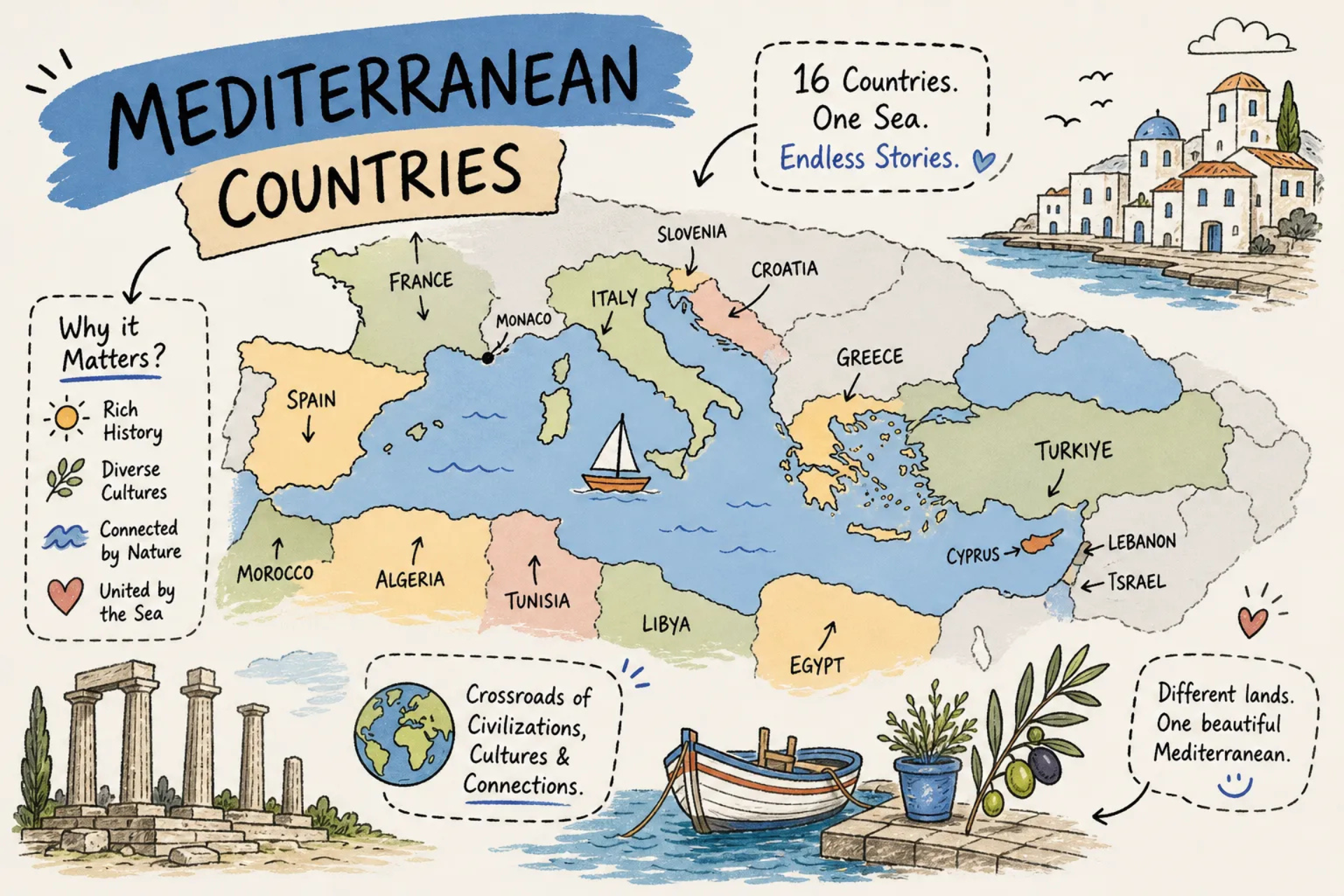
Countries in the Mediterranean Sea: The Complete Guide
Cast your mind across a map of the world and find the countries in the Mediterranean Sea, a holiday brochure of blue water, white villages, and terracotta rooftops. But sit with it a little longer and something else emerges. Three continents converge on that one body of water. Twenty-one sovereign nations share its coastline. Phoenician traders, Roman legions, Ottoman sultans, and Venetian merchants all called it their highway. No other sea on earth packs this much history, culture, and geographic drama into such a compact space.
Most travellers, if pressed, can name perhaps five or six: Spain, Italy, Greece, maybe France. But the full list of countries in the Mediterranean Sea stretches from the fjord-like inlets of Montenegro's Bay of Kotor to the ancient temples of Egypt, from Monaco's gilded harbour to Algeria's under-visited Roman ruins. For any UK traveller considering a Mediterranean cruise or a multi-centre holiday spanning more than one country, understanding the full picture is the essential first step. Skylord Cruise and Holidays specialises in precisely this kind of itinerary, seamlessly connecting multiple countries in a single trip. So here it is: every country, every territory, and every edge case explained clearly.
How many countries border the Mediterranean Sea, and why the number depends on who you ask
The standard answer, cited by authoritative bodies including UNEP's Mediterranean Action Plan and the International Hydrographic Organization, is 21 sovereign states. These are fully recognised nations with an undisputed coastline on the Mediterranean. Malta and Cyprus occupy a distinct category within that list: both are island nations entirely surrounded by the sea, rather than continental states with a coastal strip.
The figure climbs when non-sovereign entities enter the conversation. Add Gibraltar and Akrotiri and Dhekelia (both British Overseas Territories), Northern Cyprus (administered by Turkish Cypriots but recognised internationally only by Turkey), the Gaza Strip (Palestine's narrow coastal corridor), and Spain's North African enclaves of Ceuta and Melilla, and the count rises to 25 or more depending on your criteria. Two countries that sometimes appear in casual lists but do not belong there are Jordan (whose only coastline is on the Red Sea) and Portugal (entirely Atlantic-facing). For geographic and diplomatic purposes, 21 sovereign states remains the correct answer.
Countries in the Mediterranean Sea: European shores
Europe contributes the largest regional group, twelve nations strung along the northern shore, including the two island states. This is the stretch of the Mediterranean that most UK holidaymakers know best, and for good reason. Western European ports dominate the most popular cruise itineraries, and the cultural contrasts within this single region alone are extraordinary.
Western Mediterranean: Spain, France, Monaco, and Italy
Spain's Mediterranean face runs from the Costa Brava in the north to the Costa del Sol in the south, with Barcelona consistently ranking among the busiest cruise embarkation ports in Europe. France contributes the Côte d'Azur, the island of Corsica, and the glamour of the Riviera. Monaco, tiny but unmistakable, occupies its own sovereign slice of that coastline. Italy then takes over with an extraordinary sweep from the Ligurian Riviera through Rome's gateway port of Civitavecchia, down past the Amalfi Coast and on to Sicily. These four countries alone could fill a lifetime of travel, yet they represent fewer than a third of the Mediterranean's nations.
Adriatic and Ionian shores: Slovenia to Albania
Moving east along Europe's coastline, the geography becomes more dramatic and the crowds thin considerably. Slovenia has a modest but scenic stretch around the port of Koper. Croatia's Dalmatian coast, with its chain of around 1,200 islands, is one of the most photographed coastlines on earth and a firm favourite on Eastern Mediterranean cruise itineraries. Bosnia and Herzegovina holds a narrow corridor to the sea at Neum, perhaps the most curious geographical anomaly on the European shore. Montenegro's Bay of Kotor is a near-perfect natural harbour, ringed by medieval walls and limestone mountains. Albania's Riviera is increasingly attracting adventurous travellers seeking something off the beaten track.
Greece: anchor of the eastern European shore
Greece, with its thousands of islands and intricate peninsulas, anchors the entire eastern European shore. When planning which countries in the Mediterranean Sea to include in an itinerary, Greece is rarely left out, and with good reason. The sheer variety of landscapes, ancient sites, and island characters makes it a destination that rewards both first-time visitors and those returning for a fifth or sixth time.
The island nations: Malta and Cyprus
Malta and Cyprus deserve their own moment because they are the only two Mediterranean nations with no land border to another country: the sea is their entire perimeter. Malta's capital Valletta is a Baroque masterpiece, compact enough to explore on foot yet layered with millennia of Phoenician, Roman, Arab, Norman, and British history. Cyprus blends Venetian ruins, Crusader castles, and beaches that rank among the clearest in the Eastern Mediterranean. Both are popular fly-and-cruise or fly-and-stay destinations for UK travellers, and both reward those who linger longer than a single port call.
North African nations on the Mediterranean shore
Five countries form the southern shore of the Mediterranean, and they represent the sea's most culturally dramatic coastline. Separated from southern Europe by only a few hundred miles of water, these nations offer an entirely different world: ancient medinas, desert landscapes visible from the coastal hills, and ruins that predate most of Western Europe's cities.
The Maghreb: Morocco, Algeria, and Tunisia
Morocco's Mediterranean face is often overlooked in favour of its Atlantic cities, but Tangier and Tétouan face Spain directly across the Strait of Gibraltar, and the Medina of Tétouan is a UNESCO World Heritage Site. Tunisia is one of the most accessible North African destinations for UK travellers, offering the ruins of Carthage outside Tunis, the historic medinas of Sousse and Sfax, and the extraordinary Roman amphitheatre of El Jem on the eastern coast. Algeria's Mediterranean coastline is largely under-visited, carrying a rich layering of Roman and Ottoman heritage that rewards those willing to explore beyond the obvious itineraries.
Eastern North Africa: Libya and Egypt
Libya's Mediterranean shore holds some of the most remarkable Roman ruins on earth, including Leptis Magna, a city whose scale and ambition once made it one of the great urban centres of the Roman Empire. The FCDO currently advises against all travel to Libya due to ongoing security risks, so this remains a destination for the future rather than the present. Egypt is the region's headline draw: Alexandria was founded by Alexander the Great and sits directly on the Mediterranean, while the proximity of Cairo and the Pyramids makes Egypt a natural anchor for Eastern Mediterranean itineraries. The UNESCO-listed necropolis of Memphis lies a short drive from Cairo, making it an easy and compelling addition to any Egypt port call.
West Asian nations on the Mediterranean coast
The Levantine shore is the Mediterranean's most historically layered edge. Turkey, Syria, Lebanon, and Israel form a coastline where Phoenician traders built the first alphabet, where Crusader knights constructed castles still standing today, and where ancient cities have been continuously inhabited for longer than most civilisations have existed.
Turkey: where two continents meet the sea
Turkey's Mediterranean coast is one of the most popular cruise destinations in the region for UK travellers. The Turquoise Coast between Bodrum and Antalya is a signature cruise itinerary, combining ancient Lycian ruins, rock-cut cliff tombs, and water of extraordinary clarity. Istanbul, though technically on the Bosphorus rather than the Mediterranean proper, is a well-established regional gateway for Eastern Mediterranean voyages, and it remains one of the great cities of the world. Turkey's transcontinental geography, straddling Europe and Asia, makes it unlike any other Mediterranean nation.
Syria, Lebanon, and Israel: the Levantine shore
Lebanon's Beirut was long regarded as a cultural and commercial centre of the Levant, and its coastal site of Byblos is among the oldest continuously inhabited cities on earth. Israel's Tel Aviv sits directly on the Mediterranean with a thriving food, design, and arts scene quite unlike anything else on the sea's eastern shore. Syria's coastline includes the ancient city of Latakia, though the FCDO advises against all travel to Syria and there is no functioning British Embassy in Damascus; this is a destination that must wait for more stable times. Any traveller researching the Levant should check the latest FCDO travel advice before making any plans.
The edge cases: territories, dependencies, and disputed coastlines
This is where the geographic count becomes a genuine puzzle. Different sources quote different totals because they draw the line at different points between sovereign statehood and administrative control. Understanding these edge cases is what separates a thorough answer from a superficial one.
British territories on the Mediterranean: Gibraltar and Akrotiri and Dhekelia
Gibraltar sits at the western entrance to the Mediterranean, occupying the southern tip of the Iberian Peninsula. A British Overseas Territory since 1704, it is one of the most strategically significant points on the sea and a distinctive port call on Western Mediterranean cruise itineraries. Akrotiri and Dhekelia are the UK's Sovereign Base Areas on Cyprus, retained when Cyprus gained independence in 1960. Both territories appear on Mediterranean maps, but neither is a sovereign state, which is why they sit outside the core count of 21.
Spanish enclaves, Northern Cyprus, and the Gaza Strip
Ceuta and Melilla are Spanish autonomous cities on the North African coast, geographically enclosed by Morocco, with their own Mediterranean shorelines. Northern Cyprus is administered by Turkish Cypriots and recognised internationally only by Turkey; UK passport holders must enter via the Republic of Cyprus and cross at a designated Green Line checkpoint. The Gaza Strip gives Palestine its narrow Mediterranean coastline, a strip of coast carrying enormous historical and political weight. Add these entities to the 21 sovereign states and you arrive at a count of 25 or more, depending on your definitions. The core geographic answer remains 21; everything else is context.
How many countries in the Mediterranean Sea can you visit in a single trip?
Knowing that 21 countries share this one sea changes your entire approach to planning a trip here. A single cruise or multi-centre itinerary can move you from Spanish tapas bars to Moroccan medinas to Greek island chapels within a fortnight, and that breadth of experience is something no single-country holiday can offer. The Mediterranean's compact geography is the key: ports are often only a day's sail apart, and its many closely clustered harbours make it exceptionally cruiser-friendly.
The three classic itinerary arcs each offer something distinct. The Western Mediterranean, covering Spain, France, Monaco, and Italy, is the most popular for UK departures and suits travellers who want city culture alongside the sea. The Eastern Mediterranean, ranging across Greece, Turkey, Croatia, and Montenegro, offers more dramatic scenery and deeper historical layering. A combined Grand Mediterranean voyage bridges both, giving passengers the full sweep of the sea's character in a single extended journey.
Skylord Cruise and Holidays is built precisely for this kind of travel. As a UK-based operator specialising in Mediterranean cruise packages and multi-centre holiday combinations, Skylord plans the full itinerary from UK departure to return, whether the goal is a Barcelona & Summer 2026 cruise, or Barcelona & Summer 2027 Med Cruise & Stay, or a tailor‑made package pairing Rome, Florence and Venice in one tripThe expertise is already in place; all you need to bring is curiosity.
The Mediterranean is a world, not a destination
The Mediterranean is not a single place. It is 21 sovereign nations, several territories, and thousands of years of intersecting civilisations arranged around one ancient sea. When mapping out the countries in the Mediterranean Sea, a useful regional breakdown is: twelve European nations (including Malta and Cyprus as island states), five North African nations, and four West Asian nations forming the recognised core, a classification aligned with UNEP's Mediterranean basin groupings, though it is worth noting that Cyprus's geographic position in Asia and the inclusion of disputed territories can shift the count depending on the criteria applied. Beyond the core sit the edge cases, the territories and disputed coastlines that push the figure higher.
The best way to understand the Mediterranean is not to study it on a map but to move along its coastline, watching the architecture shift from Gothic to Ottoman to Baroque to modernist, the food transform from paella to tagine to mezze, the languages change at every port. That journey is entirely achievable in a single trip. At Skylord Cruise and Holidays, expert itinerary planning takes care of everything from departure to return, so the only thing you need to do is arrive ready to be surprised by just how much this one sea contains.