The Ultimate Niagara Falls Travel Guide for UK Visitors
The Ultimate Niagara Falls Travel Guide for UK Visitors

There are very few places on earth that make you feel genuinely small, and Niagara Falls is one of them. The sheer volume of water pouring over those precipices, commonly cited at roughly 2,400 cubic metres per second (several hundred thousand cubic metres per minute) at peak flow, produces a sound you feel in your chest before you hear it with your ears. Millions of visitors arrive each year, yet most spend only a few rushed hours before moving on, missing everything that makes it extraordinary. This guide is for UK visitors who want to do it properly.
Beyond the obvious photo stop, the falls reward those who come with a well-chosen viewpoint, good timing, and a sense of how the site connects to the broader North American journey. For travellers building a multi-city adventure, specialists like Skylord Cruise and Holidays can help build seamless multi-centre itineraries that treat the falls as a proper stopover rather than an afterthought. Whether you have one day or three, what follows gives you the framework to make every hour count.
The Best Time of Year to Visit as a UK Traveller
The counterintuitive truth about visiting Niagara Falls is that its most spectacular period has nothing to do with summer. Mid-September through early October delivers warm, comfortable temperatures, thinner crowds after the August rush, and autumn foliage framing the gorge in copper and amber. Nearly all major attractions and boat tours remain fully operational, so you lose nothing by avoiding the busiest months. By contrast, July and August, particularly at weekends, can feel relentless, with queues at every viewpoint and parking limited, with waits noticeably longer during peak periods.
Arriving by 9am, or as attractions open, transforms what you see. Early mornings often offer softer light and good chances of rainbows in the spray, and the viewpoints breathe. Late afternoon, from around 6pm onwards, is a second window worth noting, with the added bonus of staying on for the illuminated falls after dark. Choose a weekday in late September and you have the ideal combination of conditions and genuine breathing room.
Canada or the USA: Choosing Which Side to Base Yourself On
The Canadian side is where the most famous panorama lives. Standing at Table Rock or in Queen Victoria Park, you face Horseshoe Falls straight on, with the full curtain of water stretching across your entire field of vision. Both viewpoints are free and accessible around the clock. The Canadian side also has a more developed visitor area, with the attractions of Clifton Hill, the Fallsview casino district, and the Skylon Tower all within walking distance. The trade-off is cost: hotels on this side carry a significant premium, particularly any room marketed with a falls view, where peak-season rates run from C$250 to C$600 per night.
UK visitors often overlook the New York State side, but it holds its own. Prospect Point gives you the strongest head-on view of American Falls, while Terrapin Point on Goat Island is the best U.S.-side vantage for Horseshoe Falls. Niagara Falls State Park, the oldest state park in the United States, surrounds these viewpoints and is free to explore on foot. Accommodation on the U.S. side is considerably cheaper, with comfortable midrange hotels averaging US$120 to US$220 per night.
Moving between the two sides is straightforward. Rainbow Bridge is a short pedestrian walk across the international border, open 24 hours a day. The WEGO hop-on, hop-off bus operates on the Canadian side and connects the main Canadian attractions once you have crossed; it does not run across the bridge itself.
The Viewpoints and Natural Spectacles Worth Planning Your Day Around
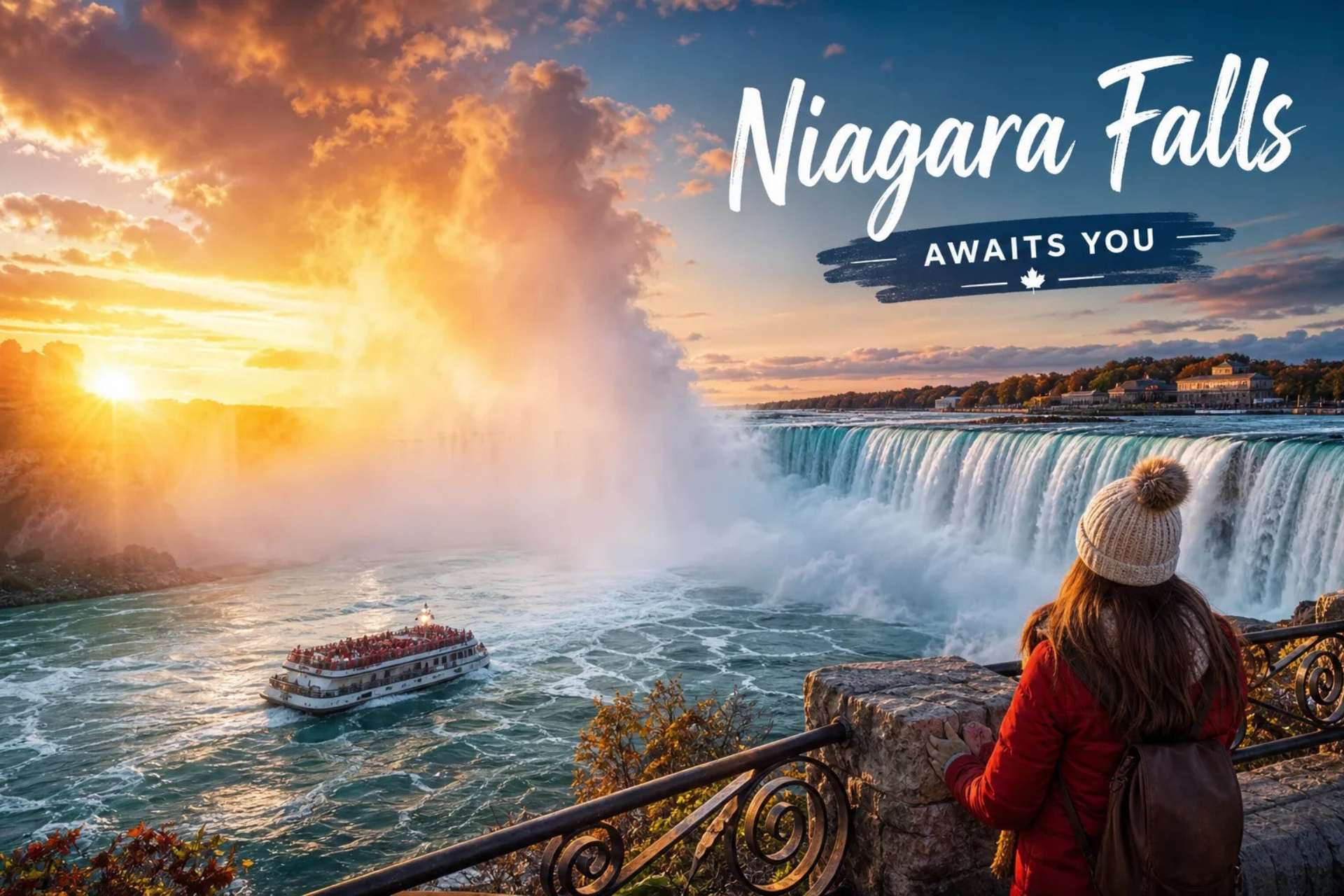
Horseshoe Falls carries the majority of the Niagara River's flow and is where the full spectacle concentrates. The best views are from Table Rock or Queen Victoria Park on the Canadian side, both free and open day and night. Terrapin Point on the U.S. side offers a compelling alternative angle. American Falls and the narrower Bridal Veil Falls sit alongside it on the New York side, best appreciated from Prospect Point or Luna Island. The Prospect Point Observation Tower is worth the modest fee of around US$1.25 for an elevated view that captures all three falls together.
Canadian vs American Perspectives
Understanding the geography before you arrive prevents a common mistake: many visitors assume both sides look identical. They do not. The Canadian perspective is wider and more sweeping; the American perspective is closer and more immediate. Deciding which feeling you want to prioritise helps you plan where to spend your first hour, especially if your time is limited.
Natural viewpoints are free and open around the clock, which means there is no excuse for missing the illuminated falls after dark. It is also worth checking whether a live webcam feed is available from the official Niagara Parks Commission site before you travel, a useful way to get a sense of current conditions, mist levels, and lighting at any time of day.
Boat Tours and Up-Close Experiences You Need to Book Ahead
Maid of the Mist and Niagara City Cruises
Maid of the Mist departs from the U.S. side; Niagara City Cruises (formerly Hornblower) departs from near Queen Victoria Park on the Canadian side. Both take you into the basin at the foot of the falls, and the provided ponchos become genuinely necessary rather than ceremonial. Maid of the Mist operates from approximately 24th April through 8th November in 2026, with tickets at US$30.25 for adults and US$19.75 for children aged 6 to 12. Niagara City Cruises runs from 1st May through late November, priced at C$47.95 for adults and C$32.95 for children aged 3 to 12, before Ontario's 13 per cent HST. The experience on both is comparable; your choice largely depends on which side you are spending the day on. Prices and dates are accurate at time of writing, check operator sites for current availability before booking.
Cave of the Winds
The boat tour puts you near the falls; Cave of the Winds puts you inside them. Wooden walkways descend to platforms positioned directly beside Bridal Veil Falls on the U.S. side. The Hurricane Deck, the closest platform, puts you within metres of the waterfall's base. Adult tickets run around US$23 in peak season. This is not about viewing the falls; it is about standing inside the experience. Book it in the morning when temperatures are cooler, and carry nothing you would not want soaked.
Pairing Niagara Falls with Toronto, New York or Montreal
The Niagara area sits at an unusual geographical crossroads, which is what makes it such a natural fit for a multi-centre North America itinerary. Toronto is around 130 kilometres away and reachable in under two and a half hours via GO Transit's direct weekend train from Union Station to Niagara Falls GO Station, with WEGO buses connecting to the main attractions from there. Buffalo, New York, is only 30 to 40 minutes by car. New York City is roughly nine hours by Amtrak's Maple Leaf service, a scenic journey that uses the falls as a natural midpoint. Montreal can be included as a third city by looping east from Toronto via VIA Rail.
For UK travellers building a two or three-week North America trip, the falls become the connector rather than the destination. Planning the logistics across two countries, with different border rules, currencies, and transport systems, is exactly where working with an experienced operator pays off. Skylord Cruise and Holidays specialises in joined-up multi-centre itineraries that keep every leg of the journey coherent, from the first flight to the final transfer.
Border Crossings, UK Entry Requirements and Where to Stay
The U.S., Canada border crossing at Niagara is one of the busiest land crossings in North America, and UK visitors need valid authorisation for both countries. For entry into the United States, UK citizens require an approved ESTA (Electronic System for Travel Authorisation), applied for online before departure. For entry into Canada by air, a Canadian eTA (Electronic Travel Authorisation) is required; however, if you are crossing into Canada by land from the U.S., the eTA is generally not required, though a valid passport is essential in both directions. Carry your passport at all times. The Rainbow Bridge pedestrian crossing is open 24 hours and is how most day-trippers move between sides.
Border wait times at Rainbow Bridge vary considerably. Weekday mornings typically run 15 to 30 minutes in each direction; summer weekends can stretch to an hour or more. The Canadian Border Services Agency's CanBorder app and the U.S. CBP Border Wait Times tool both show live crossing estimates, and checking these before you set off takes less than a minute. For the shortest waits, travel on a weekday and avoid the 10am to 4pm window during summer months.
On the accommodation question, the most practical strategy for most UK visitors is to stay on the U.S. side to reduce costs and cross into Canada for the day. Budget motels near Niagara Falls State Park start around US$70 to US$140, while comfortable midrange hotels average US$120 to US$220.
If the Fallsview experience is your priority, the Hyatt Regency Fallsview and Niagara Falls Marriott Fallsview both offer direct views of Horseshoe Falls, with peak-season rates running from approximately C$300 to C$600. When booking on the Canadian side, select a room explicitly labelled "Horseshoe Falls view" rather than simply "falls view," as some rooms face the American Falls, the river, or nearby buildings.
Building Your Niagara Falls Itinerary
The falls earn their reputation every single day, but the visitors who leave genuinely moved are those who came prepared. Choose late September over August. Arrive early, stand at Table Rock, board a boat, and walk the Cave of the Winds platform at least once. Give yourself a minimum of two days rather than one rushed afternoon, the first for the Canadian-side panoramas and an evening illumination, the second for the U.S.-side experiences and a morning crossing back. The two days give you enough time to absorb the boat tours, the walking platforms, and the free natural viewpoints without feeling rushed.
If this is one chapter of a larger North America trip, taking in Toronto, New York, or Montreal, treat it as the connecting chapter it naturally is. The geography makes multi-city planning logical; the logistics make working with a specialist sensible. Skylord Cruise and Holidays builds multi-centre North American itineraries that incorporate stopovers like this as fully planned chapters, covering transport connections, accommodation, and border-crossing guidance. The falls will be as powerful as ever; it is the preparation that determines how much of that power you actually feel. Contact Skylord Cruise and Holidays to start building your North American itinerary.